

See more. Stay ahead.
You can't protect what you can't see. Our Vulnerability Operation Center gives your organization full visibility over its attack surface — internal and external — so you identify, prioritize, and fix weaknesses before threat actors do.
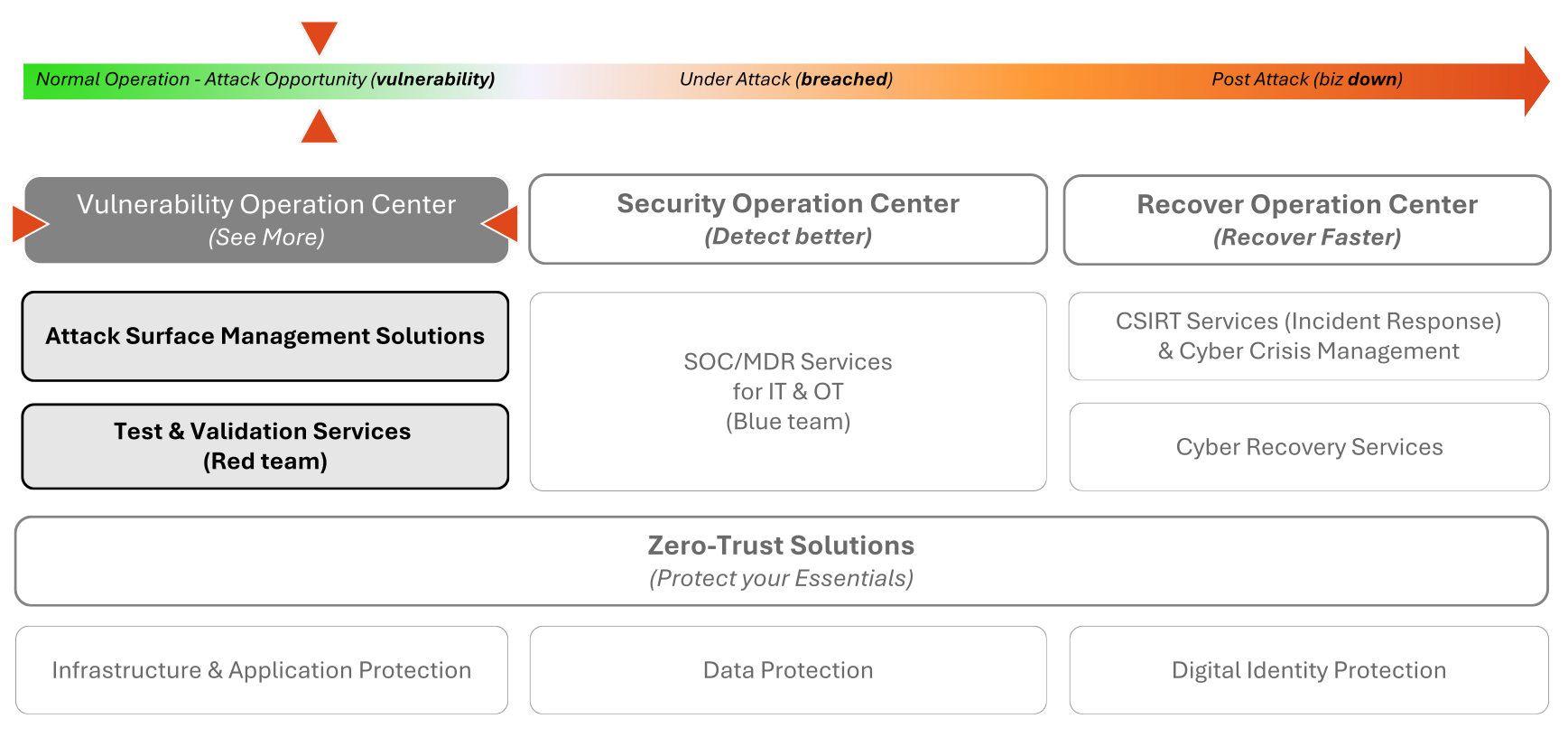
VOC Modules and Services
Use Cases
The VOC (Vulnerability Operations Center) is a system that manages IT and OT vulnerabilities within an organization. This operational center ensures 360-degree visibility over your internal and external security flaws, handles contextual prioritization, and suggests, orchestrates, or performs remediations for you. Our VOC platform and services allow your organization to reduce its attack surface, master cyber risks, and reinforce data protection, limiting the pressure on the SOC, as most attacks can't simply happen!
Features & Modules
VOC Platform (core)
Our platform allows agnostic data aggregation from all the security tools in your organization (CTI, VM, EASM, ITDR, CSPM, CTEM, Endpoint and OT sensor, etc.), whereas it can benefit from solutions that are offered as part of our VOC pillar. Onboarded Vulnerability Intelligence enables your teams to evaluate the real threats posed to your specific attack surface by each of the known 300,000+ CVEs. Risk-based vulnerability management is no more a dream: aggregate and standardize all of your threat assessment practices, whether automated or hand-crafted, and enrich them with business context and your risk analysis so that you (or we) can finally create risk-based remediation plans and align their priorities with your organization's business challenges. Regardless of the security tools deployed in your organization, you (or we) ruled them all through a single console to manage data, risks and the vulnerability management cycle.
The following modules, described as standalone components part of a Continuous Threat Exposure Management suite, can be added to the core VOC platform and services:
- Brand Protection and External Attack Surface Management (EASM)
- Endpoint, Network, and Application Vulnerability
- Cloud Security Posture
- Identity Security Posture
- Bring Your Own Tools (BYOT) as our VOC platform offers 100+ connectors
Managed Services
Abilene Solutions offers a tiered model to address your vulnerability management and remediation goals. Our QOP approach with three tiers map naturally to an "advise → coordinate → execute" progression, which fits with any customers wherever they sit on the capability/capacity spectrum, without going into an all-or-nothing managed service. A few things worth mentioning into all three tiers, with depth varying by level:
Risk appetite alignment. intake at engagement start: criticality definitions, SLA targets by severity, acceptable risk thresholds, exception authority. This shapes everything downstream and prevents scope disputes.
Scope coverage decisions. which vulnerability classes we cover: traditional infrastructure CVEs, web application vulns, cloud misconfigurations, container/image vulns, identity/IAM issues, code-level (SAST/SCA), exposed secrets, attack surface findings. Many providers underestimate how messy this gets — "vulnerability" means very different things across these domains.
Tooling model. operate the customer's existing tools, bring your own platform, or hybrid. Each has trade-offs for portability, margin, and onboarding speed. We usually enforce our core VOC platform and ingest the customer's existing tools without operating them solely.
Ramp paths between tiers. Many customers want to start at Qualify and graduate to Orchestrate or Perform as trust builds. We have clean upgrade paths (data continuity, tooling continuity, SLA evolution) from one tier to the upper one.
Co-delivery with MSPs. In many engagements, especially Tier 2/3, we are working alongside the customer's existing MSP or managed patching provider. RACI is key to define explicitly — who patches, who validates, who owns the SLA — to avoid finger-pointing.
Compliance alignment. Given a CMMC focus, worth noting that this service line maps directly to RA (Risk Assessment), SI.L2-3.14.1 (flaw remediation), CM (Configuration Management), and the continuous monitoring expectations across multiple frameworks. Looking for a specific compliance framework is optional in tier2 and tiers3 (out of scope in tier1).
Pricing models. Tier 1 typically prices per asset / per ticket (analyst intake). Tier 2 adds a coordination/platform fee. Tier 3 prices on outcomes — per asset remediated, per SLA tier, or as a fixed managed service with volume bands.
Tier 1 — Qualify (Advisory / Analyst-Led)
Positioning: "We make sense of the noise so your team can act with confidence."
Operational model: We work alongside the customer's internal IT/security/ops staff. We don't touch production systems. The customer retains full ownership of remediation execution.
Who it's for:
- Mature organizations with capable internal IT and patching teams who are drowning in scanner output
- Customers with strict change control or regulatory constraints that limit third-party access (defense, healthcare, financial services)
- Organizations early in their VM journey who need to build internal muscle rather than outsource it
- Customers with low risk appetite for external parties making changes
Core activities:
- Ingest findings from the vulnerability scanners and consolidate across sources
- Deduplicate, correlate, and validate findings — eliminate false positives and scanner noise
- Contextual risk scoring: combine CVSS with EPSS, KEV (CISA Known Exploited Vulnerabilities), asset criticality, exposure, and compensating controls already in place
- Prioritize against business context — what's actually exploitable and reachable vs. theoretical
- Produce remediation guidance: specific patches, configuration changes, workarounds, or compensating controls per finding
- Identify root causes and systemic issues (e.g., "60% of your criticals trace back to three unpatched gold images")
- Advise on SLA design, exception handling, and risk acceptance workflows
- Executive and operational reporting; metrics and trend analysis
Deliverables:
- Prioritized remediation worklist with clear ownership recommendations
- Weekly/monthly analyst reports
- Risk acceptance documentation support
- Program-level recommendations and KPI dashboards
SLA structure: Typically, time-to-triage and time-to-prioritize SLAs (e.g., critical findings analyzed within 4 hours, prioritized worklist delivered within 24 hours). Remediation SLAs remain the customer's responsibility.
What it explicitly does NOT include: Ticketing system integration, automation, test, and hands-on remediation, change implementation.
TAM service: the tier1 VOC service is available as a module of the TAM support service, focusing on high and critical findings, leveraging a consumption-based model (service unit from a pre-paid retainer) or as a forfait.
Tier 2 — Orchestrate (Coordinated / Workflow-Driven)
Positioning: "We drive the remediation process end-to-end — your teams execute, we make sure nothing falls through the cracks."
Operational model: We own the process and the coordination. The customer's IT/ops teams (or their MSP) still perform the actual remediation work, but you orchestrate the workflow, track progress, escalate, and close the loop. This is the "remediation program-as-a-service" tier.
Who it's for:
- Mid-market and enterprise customers with capable execution teams but weak coordination across silos (network, server, endpoint, cloud, app teams)
- Organizations where vulnerabilities are consistently missing SLAs because no one owns the handoffs
- Customers who want measurable VM program maturity improvement without giving up operational control
- Organizations with distributed IT or multiple MSPs that need a unifying layer
Core activities:
- Everything in Qualify, plus:
- Integration with the customer's ITSM (ServiceNow, Jira, Freshservice) — automated ticket creation, assignment, and lifecycle tracking
- Workflow design: routing rules by asset type, owner, criticality, environment
- Active remediation coordination — chasing owners, facilitating change advisory board (CAB) approvals, brokering between teams
- SLA enforcement and escalation management
- Patch and remediation campaign management (e.g., coordinated rollouts of critical patches across the estate)
- Exception and risk acceptance workflow management with documented sign-off
- Verification scanning and closure validation after the customer remediates
- Compensating control design and tracking when remediation is delayed
- Integration with CMDB to maintain asset-to-owner mapping accuracy
- Regular operational reviews with customer stakeholders
Deliverables:
- Operational remediation tickets in customer's system of record
- SLA compliance reporting (per team, per asset class, per severity)
- Campaign management plans and progress reports
- Exception registers
- Monthly/quarterly program reviews
SLA structure: Time-to-ticket, time-to-assignment, time-to-escalation, and program-level SLA compliance metrics. We are accountable for the process meeting SLA; the customer is accountable for the execution. Joint SLAs work well here.
What it explicitly does NOT include: Direct test or production patching, configuration changes, or system access. We are the conductor, not the musician.
Tier 3 — Perform (Fully Managed Remediation)
Positioning: "We find it, we fix it, we prove it's fixed. You get outcomes, not tickets."
Operational model: You take operational accountability for remediation execution. Your team (or a tightly integrated delivery partner) has the access, tooling, and change authority to actually implement fixes within agreed scopes and change windows.
Who it's for:
- Customers without sufficient internal IT capacity to keep up with remediation backlog
- Organizations consolidating MSP relationships and wanting VM execution bundled in
- Mid-market customers who've tried Qualify or Orchestrate and concluded their internal execution is the bottleneck
- Customers in high-regulation environments who need demonstrable, auditable remediation outcomes (think CMMC, PCI, HIPAA)
- Cloud-heavy customers where IaC-based remediation can be automated more aggressively
Core activities:
- Everything in Qualify and Orchestrate, plus:
- Direct remediation execution within agreed scopes:
- Patch deployment (OS, applications, firmware) via the customer's patch management tooling or yours
- Configuration hardening (CIS benchmark alignment, secure baselines)
- Cloud misconfiguration remediation (often via IaC pull requests or guardrail enforcement)
- Vulnerability mitigation through compensating controls (firewall rules, WAF policies, network segmentation)
- Certificate renewal and rotation
- End-of-life software replacement coordination
- Change management execution within customer's CAB processes
- Maintenance window operations and rollback planning
- Emergency response for critical/zero-day vulnerabilities (KEV additions, actively exploited CVEs)
- Post-remediation validation through targeted re-scanning
- Continuous improvement: feeding remediation learnings back into hardening standards and gold images
Deliverables:
- Completed remediations with full audit trail
- Change records and rollback documentation
- Outcome-based reporting (mean time to remediate, backlog reduction, exposure reduction)
- Audit-ready evidence packages
- Continuous tuning of automated remediation playbooks
SLA structure: Outcome-based — mean time to remediate (MTTR) by severity, percentage of vulnerabilities remediated within window, backlog reduction targets, KEV remediation timelines. This is where you can offer the strongest commercial commitments because you control execution.
Scope boundaries to define explicitly:
- Which asset classes are in scope (servers, endpoints, network gear, cloud, applications, OT)
- Which remediation actions are pre-approved vs. require customer sign-off
- Change window definitions and emergency change procedures
- Exclusions (e.g., legacy/EOL systems, custom applications without source access)
Cyber Threat Intelligence
Use Cases
Equip your SOC with tactical and technical Threat Intelligence feeds to improve your threat detection:
- Minimize Attack Surface: Quickly identify and mitigate malicious activity by correlating internal data with external threat intelligence
- Proactive Defense: Detect and block threats before they escalate, strengthening security posture.
Features
- Premium-Quality sources handpicked by our expert team to guarantee reliability and accuracy
- Rich Context & Continuous Updates with deeper insights, including detailed threat data, risk scores, and information on threat types and actors
- Our feed adapts to the lifecycle of threats, ensuring you always stay ahead of the latest risk
IoC Feed
A unified feed that includes:
- 11 specialized sources
- 2M+ IoC database
- 9 asset types
Effortless Integration with pre-built connectors or via a TAXII server. All data is delivered in STIX format for easy automation.
Brand Protection & External Attack Surface Management
Use Cases
Our platform and services provide you with 360-degree visibility over your extended EXTERNAL attack surface, with a real-time, continuous scan of the Internet. You know when secrets and credentials are leaked, when your VIP accounts are impersonated on social media, when attacks get prepared on the dark web, if your exposed are vulnerable, or if sensitive data is publicly-accessible. We prioritize the most critical exposures, leveraging a combination of ML models and analyst validations. Our findings are actionable for swift and streamlined remediation.
Features
Visibility
Internet-Wide Scan: coverage against Data Leaks, Shadow IT, Exposed Credentials, Phishing, Social Media, and Dark Web activities. 6B+ data points processed every day.
Agentless 24/7 scanning: a combination of keyword-matching, pivoting, active search and open source harvesting, monitoring all layers of the internet in real-time. 4.3B IP addresses scanned every day.
In-depth matching at document-level: ability to match inside the content of documents and datasets. Every month, CybelAngel detects more than 115B documents publicly available on file servers.
AI-Powered noise cancellation
Specialized Machine Learning models: algorithms developed specifically for EASM use cases, trained over 10 years on a dataset greater than 100TB.
Custom Alert Scoring: incident scoring based on metadata, content, and what’s critical for your industry and organization. Scores vary from 1/4 to 4/4.
Low False Positive Rate: only pre-investigated and verified security issues reaching your inbox.
Human-Led Prioritization
Dedicated Analyst: contextualized Incident Reports with confirmed attribution, redacted by a Cyber-Analyst who knows your requirements.
In-depth Investigation: technical details and exposed data are cross-referenced across all your findings, to detect multi-vector exposures.
Risk Analysis: assessment of the business risks related to the exposure, to inform your decision on the best course of action.
Maximized Actionability
Efficient Remediation Services: a dedicated team to support and offload your takedown efforts, when needed.
Detailed Attribution data: a breakdown of the Who, What, When & Where of every exposure.
Seamless Integrations: APIs, off-the-shelf connectors, no-code automation, and solutions architects available at your fingertips.
Modular Offering
Asset Discovery & Monitoring overview
Detect and secure vulnerable shadow services before they are hacked:
- Internet-facing assets
- Exposed APIs
Data Breach Prevention
Monitor, detect, and secure publicly-accessible sensitive data before they are breached.
- Connected storage devices
- Cloud storages &applications
- Code repositories
- Cloud Databases
Account Takeover Prevention
Monitor and detect critical credentials leaks before they are compromised.
- Infostealers
- Unsecure databases
- Data Leaks
Brand Protection
Monitor, detect, and take down malicious domains to keep your brand secure.
- Domains
- Mobile Application Stores
- Social media networks (40+)
Dark Web Monitoring
Monitor hacker activities and mitigate targeted attacks planned on Dark Web forums, messaging apps, etc.
- Deep web, Dark web
- Instant messaging applications
Expert Support
- Take-downs and remediation
- On-demand investigations
- Cyber due diligence and third-party assessment
Cloud Security Posture Management
Use Cases
Cloud Security Posture Management (CSPM) is a category of security tools focused on continuously identifying and remediating cloud misconfigurations, compliance violations, and risks across cloud infrastructure (IaaS/PaaS environments like AWS, Azure, GCP, and increasingly Kubernetes). CSPM is increasingly bundled into CNAPP (Cloud-Native Application Protection Platform), which combines CSPM with CWPP (workload protection), CIEM (entitlements), DSPM (data posture), and KSPM (Kubernetes posture).
Features & Modules
The core features are:
- Visibility across multi-cloud environments. Maintain a continuously updated inventory of every cloud asset (compute, storage, identity, networking, serverless, containers) across all accounts, subscriptions, and regions. You can't secure what you can't see, and shadow accounts/resources are a primary risk.
- Misconfiguration detection. Identify deviations from secure baselines — publicly exposed S3 buckets, overly permissive security groups, unencrypted volumes, disabled logging, root account usage, MFA gaps, etc. Misconfiguration remains the leading cause of cloud breaches.
- Continuous compliance monitoring. Map cloud configurations against frameworks (CIS Benchmarks, NIST 800-53, PCI DSS, HIPAA, SOC 2, ISO 27001, FedRAMP, CMMC) and produce evidence on demand rather than scrambling at audit time.
- Risk prioritization. Move past raw alert volume toward context-aware risk scoring — a misconfigured bucket holding PII reachable from the internet matters more than one in an isolated dev account.
- Remediation acceleration. Shorten mean time to remediate through guided fixes, IaC suggestions, or automated guardrails.
- Drift detection. Catch when production configurations diverge from approved IaC templates or known-good baselines.
- Shift-left integration. Surface issues in IaC (Terraform, CloudFormation, ARM, Bicep) before deployment, not just after.
Identity Security Posture Management
Use Cases
Identity Security Posture and Identity Detection and Response address what has become the dominant attack vector: identity is the new perimeter, and the majority of breaches now involve credential compromise, MFA bypass, or abuse of legitimate access rather than malware.
A quick terminology note first: the industry-standard acronyms are ISPM (Identity Security Posture Management) and ITDR (Identity Threat Detection and Response). ISPM is the preventive/posture side, which focuses on the state of your identity infrastructure — finding misconfigurations, excessive privileges, and weaknesses before they're exploited. ITDR is the detection/response side, which focuses on active threats against identities — detecting credential theft, token abuse, privilege escalation, and lateral movement in progress. Most modern platforms combine them, similar to how CSPM and CWPP converged into CNAPP.
Features & Modules
The core features and modules are:
ISPM (VOC companion) goals include:
- Identity inventory and visibility. Continuously discover every human and non-human identity (service accounts, machine identities, OAuth apps, API keys, workload identities) across AD, Entra ID, Okta, Ping, Google Workspace, AWS IAM, and SaaS apps. Shadow identities and orphaned accounts are a major risk.
- Misconfiguration detection. Surface weak MFA enrollment, legacy authentication still enabled, password policy gaps, stale accounts, dormant privileged users, unconstrained delegation in AD, risky conditional access policies, and similar exposures.
- Privilege and entitlement analysis. Identify excessive permissions, standing privileged access, privilege escalation paths (especially in AD/Entra ID — Tier 0 exposure, ADCS misconfigurations, shadow admins), and toxic permission combinations.
- Attack path mapping. Chain individual weaknesses into exploitable paths — e.g., compromised user → Kerberoastable service account → domain admin. This is the BloodHound-style analysis that's now table stakes.
- Compliance and policy enforcement. Map identity posture against frameworks (NIST 800-53 AC/IA families, CMMC, ISO 27001, SOC 2) and enforce policies like JIT access, least privilege, and separation of duties.
- Hygiene at scale. Track and reduce stale accounts, unused privileges, never-logged-in users, expired credentials, and certificate sprawl.
ITDR (SOC companion) goals include:
- Detect identity-based attacks in real time. Catch credential stuffing, password spray, AS-REP roasting, Kerberoasting, Golden/Silver/Diamond tickets, DCSync, DCShadow, token theft, session hijacking, OAuth consent phishing, and MFA fatigue attacks.
- Detect post-authentication abuse. Spot anomalous behavior after a valid login — impossible travel, atypical resource access, unusual privilege use, suspicious app consent grants, suspicious API calls from valid sessions.
- Detect identity infrastructure compromise. Monitor for attacks against the identity providers themselves — AD/Entra ID tampering, federation trust abuse (Solorigate-style), changes to authentication policies, backdoor account creation.
- Respond and contain. Disable accounts, force re-authentication, revoke sessions and tokens, trigger conditional access policies, and isolate compromised identities — ideally automated through SOAR or native IdP integrations.
- Investigation and forensics. Provide identity-centric timelines that correlate sign-ins, token issuance, permission changes, and resource access across the hybrid identity fabric.
ISPM/ITDR overlaps with and complements:
- IAM/IGA: governance and lifecycle — ISPM tells you what's wrong with how IGA is being used
- PAM: privileged credential vaulting — ISPM finds the privileged accounts PAM should be managing
- CIEM: the cloud IAM slice of ISPM, often bundled into CNAPP
- EDR/XDR: endpoint-centric detection — ITDR fills the identity gap that EDR can't see
- SIEM: log aggregation — ITDR provides the identity-specific detection logic that generic SIEM rules miss
Our solution covers both ISPM and ITDR, not necessarily covering all the features described above, generating findings and alerts for:
- identity breaches (username/password, tokens, etc.) available for attackers on the (public, deep, dark) web for an initial access; understand if the breach can be exploited on the identity repository (password changes, token expired?)
- check for EntraID misconfigurations that would allow the attacker to expand his control
- providing remediation suggestions, case management (resolve, snooze findings), and response capabilities (disable account, change password, etc.)
Vulnerabilty Management
Endpoint, Network, and Application Vulnerability Scan
This is the legacy and still accurate solutions that will scan your assets for known software vulnerabilities (CVEs) through the following steps:
- Identify the elements present in your information system with our asset discovery engine. Tag the most important assets, according to your business challenges.
- Scan for vulnerabilities on your servers and workstations, Docker images, network devices, and websites using our scanning engine(s), with or without an agent, in the IT and OT landscapes.
- Prioritize what really matters in your context with our AI prioritization engine, which automatically calculates the real risk of each asset vulnerability using 50+ criteria on 5 axis, generating a Contextualized Priority Score. Dashboards help you make the most appropriate decisions to achieve your goals (i.e. measure your MTTR). Send requests to third-party systems (ticketing tool, CMDB, email…) and add comments on vulnerabilities, or mark them as accepted risks so you can focus on the things you can fix.
- Remediate and fix by instructing the platform to install security patches from vendors to address your vulnerabilities, with or without an agent, via our native Patch Management module. Deploy security updates on Linux and Microsoft Windows systems, according to your configurations.
Offensive Testing & Validation
Use Cases
Our engagements ultimately help reduce the risks and impacts of cyber incidents by testing and validating your attack surface and suggesting remediation to limit your exposure and harden your assets. In-scope assets could be applications, middleware, networks, devices, and even people.
Catalog
We offer a full range of standardized consulting services available as standalone engagements or through a prepaid retainer (10 to 50 service units). The scope for each service is fixed and includes defined outcomes; however, we can work with you to reasonably customize the scope if needed.
The Service unit value (1 Service Unit=5 hours) and sizing - (S)mall, (M)edium, (L)arge - listed in this catalog are based on your organizational or network infrastructure size and are subject to adjustment based on the specific engagement objectives and desired outcome.
All services in this catalog, including related communication and documentation, are delivered in English, remotely or on-site. Local language options may be available. Please, engage with us to get more details on the service descriptions.
Security Assessment
- Active Directory Security Assessment (S:10; M:20; L:40)
- Entra ID Security Assessment (12)
- Password Cracking and Analysis Assessment (4)
- Threat Hunting Assessment (S:10; M:18; L:24)
- Vulnerability Assessment (S:4; M:8; L:12)
Application Security Assessment
- Custom Application Security Assessment (S:16, M:24)
- Mobile Application Security Assessment (8)
- Secure Code Analysis (S:10, M:16, L:22)
- Web Application Security Assessment (S:8, M:12, L:16)
- Web Service/API Test (S:8, M:12, L:16)
Penetration Testing
- External Penetration Test (S:8, M:16, L:32)
- Internal Penetration Test (S:8, M:16, L:32)
- Physical Security Testing (16)
- Wireless Network Penetration Test (8)
Specialized Testing
- Device Penetration Test (16)
- Laptop Penetration Test (8)
- Medical Device Test (16)
- SAP Penetration Test (16)
Phishing & Vishing Drill Testing
- Phishing Drill - Click and Log (S:8; M:16)
- Phishing Drill - Credential Capture (S:16; M:24)
- Vishing Drill (S:8; M:16)
Red Teaming & Adversary Exercises
> cf. separate service description in the SOC pillar
- Adversary Emulation Exercise (red team, TI led)
- Adversary Exercise Lite (S:32, Extra Time: 8 per week
- Adversary Exercise Standard (M:64, Extra Time: 8 per week)
- Adversary Simulation Exercise (red team, Full spectrum)
- Adversary Exercise Lite (S:32, Extra Time:8 per week; Physical security attacks (1 location): 16; Wireless (1 location): 8)
- Adversary Exercise Standard (M:64, Extra Time:8 per week; Physical security attacks (1 location): 16; Wireless (1 location): 8)
Automated Security Validation
> cf. separate service description in the SOC pillar
- Breach & Attack Simulation
- Automated Penetration Testing
- Continuous Threat Exposure Management
Know your exposure before your attacker does.
Every organization has blind spots. Unpatched systems, exposed credentials, misconfigured cloud assets, forgotten subdomains — attackers spend their time finding what you've missed. AI is just accelerating discovery and adversary exploitation. Vulnerability volume and velocity are really huge remediation concerns nowadays, as you need to prioritize and fix quicker.
Our VOC exists to find it first. We map your entire attack surface, monitor it continuously, and give you the intelligence you need to prioritize and act — before a vulnerability becomes a breach.
"See More" is your strategic advantage in the battle for security. It means:
- Unified Visibility: A single pane of glass showing your internal and external attack surface, security posture, and risk trends.
- VOC Excellence: A dedicated Vulnerability Operations Center that manages the entire lifecycle: Triage, Qualify, Orchestrate, Remediate.
- Risk Quantification: Translating technical vulnerabilities into business risk, so you can prioritize investments effectively.
- Continuous Hardening: A relentless process of identifying and closing gaps to shrink your attack surface over time.
- Strategic Reporting: Clear, executive-level insights into your security posture and the effectiveness of your remediation efforts.
"See More" pillar not just as a scanning service, but as a comprehensive management program that actively reduces risk through visibility, triage, and remediation.

Let our team assess your current attack surface and build a remediation plan that fits your environment and your priorities.
Everything you need to know
Choosing a partner is a major decision. Here are the questions we hear most often — answered straight.
What does "European-made technologies" mean in practice?
It means we systematically prioritise vendors headquartered and operating within Europe (including UK), whose data processing stays on European soil. This matters for data sovereignty, GDPR compliance and reducing exposure to foreign jurisdiction risks and geopolitical gambling.
Related Insights
Cyber threats evolve fast. Our experts share the latest thinking on cybersecurity trends, regulatory changes and operational best practices — so your organization stays one step ahead.

August - Top 5 vulnerabilities
Vulnerability Intelligence
July - Top 5 vulnerabilities
Vulnerability Intelligence

The Minnesota water stations attacks: lessons learned from the field
Published: August 5, 2026 | Stéphane Rabette | Reading Time: ~7 minutes