

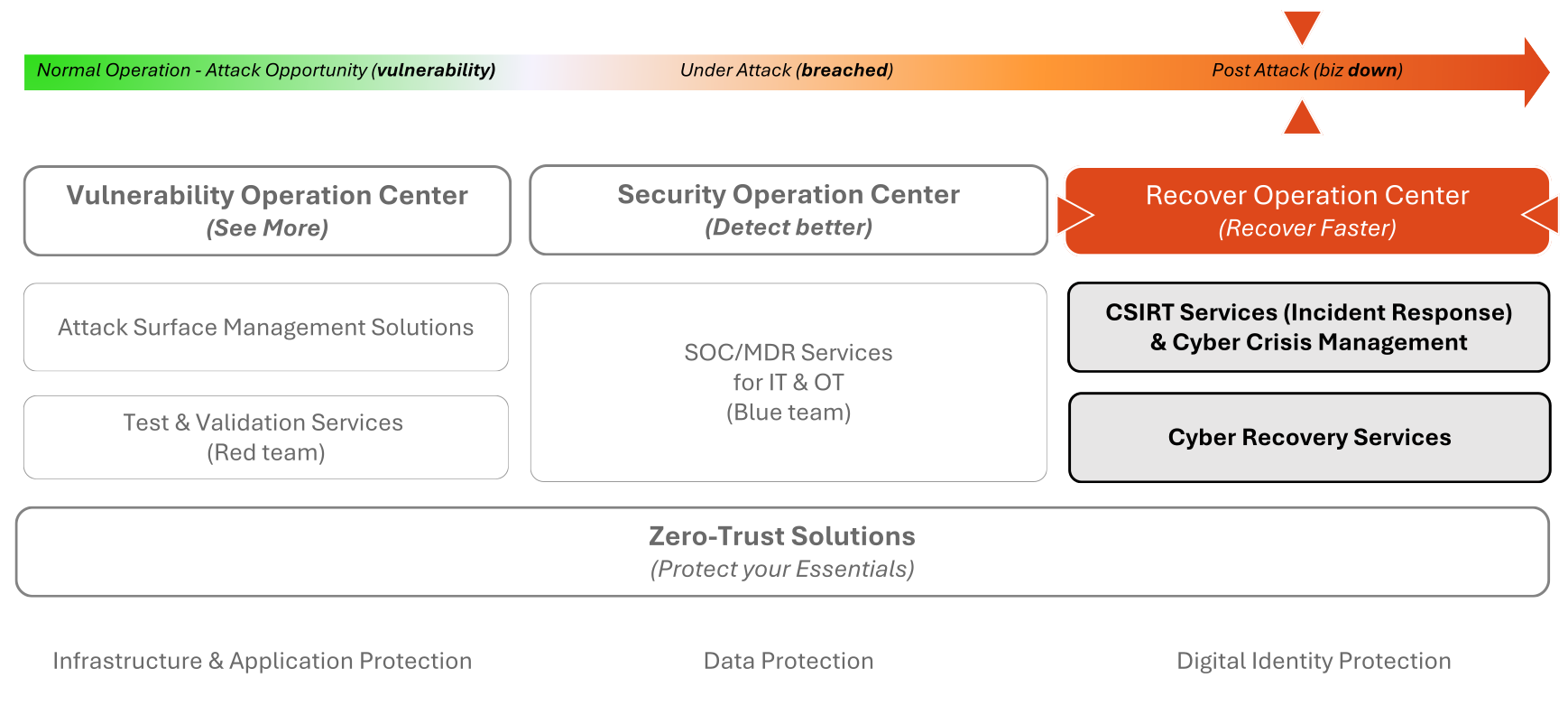
Response and Rebuild faster.
When a cyber attack hits, every minute counts. Our Recover Operation Center provides immediate incident response, crisis management and full business recovery — so you get back in control as fast as possible.
Crisis Management and Incident Response Readiness
Use Cases
Our consulting engagements assess your crisis management and incident response preparation.
The scope for each service is fixed and includes defined outcomes; however, we can work with you to reasonably customize the scope if needed. The Service unit value (1 Service Unit=5 hours) and sizing - (S)mall, (M)edium, (L)arge - listed in this catalog are based on your organizational or network infrastructure size and are subject to adjustment based on the specific engagement objectives and desired outcome.
All services in this catalog, including related communication and documentation, are delivered in English, remotely or on-site. Local language options may be available. Please, engage with us to get more details on the service descriptions.
All services are available (and sized as Small, Medium, Large) as standalone engagements or through a prepaid retainer (10 to 50 service units).
Service Features
Incident Response Plan Development
We will help you develop incident response (IR) plan materials at both a strategic and a tactical level. Strategically, we will help you with IR plan development, security policy integration, capability development, and governance. Tactically, we will help you define IR workflows, roles and responsibilities, and detection and response processes specific to your organization.
- IR Response Plan Development (S:12 < 5K employees; M:16 < 10K employees; L:24 > 10K employees)
Incident Response Plan Review
The Incident Response Plan Review is a detailed review of your existing incident response (IR) posture and focuses on analysis of your current IR capabilities, processes, and practices. In assessing your environment, and relevant standards and regulatory requirements, we will apply its expertise and breadth of experience to evaluate IR capabilities and provide prioritized recommendations for improving IR practices.
- IR Response Plan Review (S:12 < 50 pages of doc review; M:16 < 75 pages; L:20 < 100 pages)
Incident Response Plan Playbook Development
Playbooks contain incident-specific guidance for responding to a potentially chaotic situation. While an IR plan provides an overarching technical and non-technical organizational response to any cybersecurity incident, a playbook contains guidance for a specific type of incident. Playbooks are typically used for common or high-profile incident types that may require additional planning, such as specific steps to follow for responding to a malware attack.
- IR Playbook Development (S:4;M:8)
Crisis Management (ISO22361)
Playbooks contain incident-specific guidance for responding to a potentially chaotic situation. While an IR plan provides an overarching technical and non-technical organizational response to any cybersecurity incident, a playbook contains guidance for a specific type of incident. Playbooks are typically used for common or high-profile incident types that may require additional planning, such as specific steps to follow for responding to a malware attack.
- IR Playbook Development (S:4;M:8)
Additional ISO22361 collaterals from Abilene Advisors and Abilene Academy
- ISO22361 implementation
- ISO22361 training & certification: lead crisis manager
Crisis Management and Incident Response Exercices
Use Cases
Our engagements ultimately help organizations' cyber resilience by stressing your team about their incident response capabilities.
The scope for each service is fixed and includes defined outcomes; however, we can work with you to reasonably customize the scope if needed. The Service unit value (1 Service Unit=5 hours) and sizing - (S)mall, (M)edium, (L)arge - listed in this catalog are based on your organizational or network infrastructure size and are subject to adjustment based on the specific engagement objectives and desired outcome.
All services in this catalog, including related communication and documentation, are delivered in English, remotely or on-site. Local language options may be available. Please, engage with us to get more details on the service descriptions.
All services are available (and sized as Small, Medium, Large) as standalone engagements or through a prepaid retainer (10 to 50 service units).
Service Features
Incident Response-led Exercises
IR Fundamentals Training
Training series is predicated on a philosophy of equipping organizational resources with the foundational skill sets to respond to a cybersecurity incident. Preparation is multifaceted, focusing on managing cybersecurity incidents and training first line responders. The IR Fundamentals Training series helps resolve common knowledge gaps and, ultimately, helps an organization respond in a more efficient manner (Principles of Incident Response Training, Incident Commander Training, Attacking and Defending Active Directory).
- IR Training (S:8 per course)
Functional Exercise
We offers both functional exercises and drills (explained below). These exercises and drills elevate the level of your readiness testing, allowing your incident response (IR) team members to practice their roles and responsibilities, and to execute processes in one or more functional areas of an IR plan. Each exercise can vary in complexity and scope, from validating specific aspects of a plan (a drill) to validating multiple aspects of a complete IR plan (a functional exercise).
Drills are brief exercises that test a specific IR capability. Examples of capabilities that IR drills can test are: How quickly can our on-call team activate our external IR provider? Can all team members rapidly triage an alert and isolate a compromised server?
Functional Exercises are wide-scope response scenarios with hands-on elements, conducted in realistic, real-time environments involving multiple functions. An example of such an exercise is: “Your tools show critical alerts that joebloggs@xxxxxxxx.com has been phished. Demonstrate how you follow your response process—from triaging the alerts, notifying the appropriate parties, and acquiring all relevant data, to conducting the technical investigation for understanding the root cause, identifying any data loss, and concluding the investigation.”
- Functional Exercise (S:16, M:24)
Tabletop Exercise
An incident response (IR) Tabletop Exercise assembles primary stakeholders and uses a scripted incident scenario to practice incident response. The exercise facilitator releases information in a controlled manner that will guide the exercise, while each stakeholder describes their response as if it were a real incident. An IR Tabletop Exercise is an efficient way to familiarize your organization's personnel with IR practices and the exercise proactively tests existing response capabilities, including the validation of roles, responsibilities, coordination, and decision making.
- External Penetration Test (S:8, M:16, L:32)
Adversary Group-led Exercises
cf. our service descriptions from our VOC pillar.
Crisis Management Exercises (Full Spectrum including Management team)
This service is delivered by our colleagues from Abilene Advisors, based on methodologies combining ISO 27035-aligned incident response frameworks with ISO 22301-grounded business continuity testing — tailored to your threat profile, your team's maturity, and your regulatory obligations.
Key scenarios this service addresses:
- Organizations that have incident response or BCP/DRP plans but have never tested them end-to-end
- Security and IT teams that need to validate detection-to-containment procedures against realistic attack scenarios
- Leadership teams that must demonstrate crisis readiness to regulators, auditors, or boards under NIS2, DORA, or ISO 22301
- Organizations that have completed a previous exercise and want to track measurable improvement over time
- Environments where coordination between IT, legal, communications, and executive leadership has never been stress-tested
Framework & Planning Foundation
- Delivery of a complete IR and BCM framework aligned to ISO 27035 and ISO 22301, operational-ready and tailored to your environment — not a generic template.
- Development of incident playbooks and response procedures mapped to your specific threat landscape, systems, and team structure.
- Pre-exercise BCP/DRP analysis and gap assessment to identify critical processes, hidden dependencies, and untested assumptions before the exercise begins.
Exercise Design & Facilitation
- Progressive exercise typology matched to your maturity: tabletop discussions (TTX) for discussion-based scenario walkthrough, functional exercises for coordination and procedure validation, and full-scale live drills testing actual systems and real-time decision-making under pressure.
- Realistic, dynamic scenario injects — developed in collaboration with media and external partners — introducing time pressure, incomplete information, cascading events, and stakeholder simulation to replicate how teams actually respond, not how they think they will.
- Professional facilitation and exercise control throughout, with comprehensive observation and performance documentation.
Outcomes & Continuous Improvement
- Post-exercise report delivering a prioritized analysis of strengths, gaps, and specific remediation recommendations — each finding with a clear improvement path.
- Post-exercise gap analysis and remediation roadmap, turning exercise findings into structured improvement actions rather than a list of observations.
- Lessons learned integration plan ensuring findings feed back into updated playbooks and procedures.
- Continuous improvement support through regular testing cycles (recommended 2–4 times per year), post-incident reviews, and playbook updates — building measurable resilience maturity over successive exercises.
What Makes This Different
- Blameless learning environment by design: exercises are framed as capability-building, not performance evaluation — creating the psychological safety needed for teams to discover and acknowledge real gaps.
- Findings from exercises consistently surface 10–15 issues per session, including critical ones that would have been catastrophic in a real incident — covering decision authority ambiguity, unrealistic RTOs, restore procedure failures, and communication breakdowns.
- Regulatory alignment built in: exercise design and documentation support audit readiness under NIS2, DORA, ISO 22301, and ISO 27001.
Crisis Management and Incident Response Support
Use Cases
Incident Response Retainer is a pre-contracted, flexible IR service that provides guaranteed access to elite incident responders before a crisis hits — combining emergency response capacity with proactive readiness services under a single retainer. This service is ideal for organizations that want guaranteed IR capacity on standby — without paying full-time IR staff — and need to satisfy cyber insurance, regulatory or board-level requirements for a documented, tested incident response capability.
When a major incident escalates beyond technical response into an organizational crisis, support from a Lead Crisis Manager is critical; he/she becomes the central coordination authority — bridging the gap between the technical IR team, executive leadership, legal counsel, communications, and external stakeholders.
The key distinction from an IR retainer: the IR retainer covers what happened technically and how to contain it; the Crisis Management retainer covers how the organization responds, decides, communicates, and recovers as a whole. The two services are designed to operate in parallel and hand off cleanly at the recovery transition point.
Services Features
🛡️ Emergency Incident Response
The IR service pre-committed retainer is not just a break-glass emergency contract — it's a dual-purpose investment that builds cyber resilience proactively while ensuring elite response is pre-positioned and pre-priced for when the worst happens.
- 24/7 IR Hotline — immediate access to IR Consulting experts via a dedicated hotline with defined SLAs for response time.
- On-site or remote deployment — IR teams can be dispatched globally to customer locations with no geographic restrictions, while remote support begins immediately during transit.
- Scoping at no charge — initial scoping calls and Engagement Work Orders (including cost estimates) are provided at zero cost before any retainer units are consumed.
- Pre-negotiated, discounted rates — emergency IR hours billed at locked-in rates, accredited by major cyber insurers, avoiding premium surge pricing during an active crisis.
Services are consolidated under a single retainer with discounted pre-negotiated rates for emergency IR hours and additional Service Units, no geographic restraints, no forced service consumption, and a safe investment model — if no emergency response needs arise, Service Units can be redeemed for proactive IR services instead:
- Incident Response planning — IR playbook development, tabletop exercises and crisis simulation
- Adversarial testing — penetration testing and red team exercises to validate detection and response capabilities
🚨 Crisis Management Support
Lead Crisis Management support is provided as an On-Demand Retainer — guaranteed response SLA with no pre-committed hours; activation billed at retainer rate. It is also available as a Standby Retainer with pre-committed hours available on a priority basis; unused hours are partially credited toward preparedness activities.
- Dedicated Lead Crisis Manager available on short-notice activation — 24/7 during declared crisis periods
- Rapid onboarding and situational assessment within the first hour of activation
- Crisis Management Team (CMT) facilitation: chairing, decision structuring, log maintenance, and tempo management
- Regulatory notification management: NIS2 (24h/72h), DORA, GDPR (72h) — deadline tracking, notification drafting, authority liaison
- Internal and external communication coordination — consistent, legally reviewed messaging across staff, customers, partners, and media
- Executive and board interface: shielding the IR team from management pressure while keeping leadership informed and decisive
- Transition management from crisis response to BCP/DRP execution — stand-down criteria, handover coordination, premature exit prevention
- Post-crisis deliverables: crisis timeline, decision log, lessons learned report, and improvement recommendations
BCP & Cyber Recovery Readiness
🎯 Use Cases
Business continuity and cyber recovery are two disciplines that most organizations treat separately — one owned by risk management, the other by IT. In practice, a ransomware attack, a cloud provider outage, or a critical system compromise is simultaneously a cybersecurity incident and a business continuity event. When the two frameworks are not aligned, organizations discover the gap at the worst possible moment: during the crisis itself.
Most organizations have some form of BCP or DR documentation in place. The real question is whether it is actionable, current, tested, and sufficient to meet both operational recovery objectives and regulatory expectations. Under NIS2, DORA, and ISO 22301, documentation alone is not enough — regulators and auditors expect demonstrable readiness, validated RTOs, and evidence of a functioning management system behind the plans.
🛠️ Service Features
Business Continuity Management Readiness
This gap assessment service is delivered by Abilene Advisors, combining their ISO 22301-grounded gap analysis methodology with Abilene Solutions' cyber recovery expertise — giving organizations a unified view of where their BCP and cyber resilience posture actually stands, and a prioritized roadmap to close the gaps that matter most.
Key situations this service addresses:
- Organizations with existing BC or DR plans that have never been formally assessed against ISO 22301 or current regulatory requirements
- Security and IT teams that need to validate whether documented RTOs and RPOs are achievable in a real recovery scenario
- Organizations facing NIS2, DORA, or client audit requirements and needing objective, evidence-based proof of continuity readiness
- CISOs or CIOs seeking board-level justification for BCP investment with a clear risk exposure baseline
- Environments where BCP and cyber incident response plans exist in silos and have never been tested as a coordinated response
What do we offer?
- Structured gap analysis covering all 10 ISO 22301:2019 clauses — from context and leadership through planning, BIA, recovery procedures, and performance evaluation — assessed against your existing documentation, operational evidence, and stakeholder interviews.
- Evidence-based maturity scoring per clause, producing a clear compliance scorecard that distinguishes what is implemented, what is documented but untested, and what is genuinely missing — not a generic checklist.
- Typically 5–10 stakeholder interviews (BC coordinator, IT operations lead, business unit representatives, senior management) to capture how continuity works in practice versus on paper.
- Completed within 2–3 weeks from scope definition to delivery of the gap analysis report, regardless of whether ISO 22301 certification is the end goal.
Additional ISO22301 collaterals from Abilene Advisors and Abilene Academy?
- ISO22301 implementation
- ISO22301 training & certification: foundation, lead auditor, lead implementer
Cyber Recovery & DRP Readiness
The ISO 22301 gap analysis provides the framework; Cyber Recovery Readiness provides the operational substance
Operational Business Impact Analysis (BIA)
- Inventory of critical business processes with their system and application dependencies
- Formal definition of MTPD (Maximum Tolerable Period of Disruption) per process
- Definition of RTO (Recovery Time Objective) and RPO (Recovery Point Objective) validated by the business — not just by IT
- Identification of minimum critical resources required for recovery (key personnel, access rights, equipment)
- Mapping of third-party dependencies (cloud providers, SaaS platforms, critical suppliers
MVC — Minimum Viable Configuration
- Definition of the minimal set of systems and services to restore as a priority to ensure the organization's operational survival
- Asset prioritization by business criticality (tier 1 / tier 2 / tier 3)
- Documentation of reference configurations ("golden images", validated snapshots, hardened configurations) required for a clean restart
- Identification of interdependencies between MVC components that could block the recovery sequence
Cyber-resilient backup architecture and capabilities
- Assessment of the backup strategy against the 3-2-1-1-0 rule (3 copies, 2 media types, 1 offsite, 1 air-gapped/immutable, 0 verified errors)
- Verification of backup immutability against ransomware (protection against encryption or deletion by an attacker who has compromised admin credentials)
- Existence of an isolated recovery environment (clean recovery environment) separate from the production network
- Coverage of cloud, SaaS, and hybrid workloads within the backup strategy
Detailed technical DRP
- System-level recovery runbooks for each critical system (not just high-level plans) — sequence, prerequisites, commands, owners
- Definition of recovery sequences (system restart order, AD/DNS/PKI dependencies before business applications)
- Post-recovery validation procedures: how does the organization confirm a system is clean and operational before reopening it to users?
- Integration of the DRP with the cyber incident response plan (IR Plan) — defining the handover point between the containment phase and the recovery phase
Cyber-specific scenarios
- ISO 22301 gap analyses typically address generic scenarios (disaster, unavailability). Missing are cyber-adversarial scenarios such as:
- Ransomware with full encryption and data exfiltration
- Compromise of privileged access (AD, secrets vault, PKI)
- Attacker-driven destruction or corruption of backups
- Supply chain attack (critical third-party provider compromised)
Cyber recovery governance elements
- Cyber crisis RACI: who decides to switch to degraded operating mode, who authorizes recovery, who validates that the environment is clean?
- Crisis communication procedures in the event of a major cyber incident: customers, regulators (NIS2/DORA notification within 24h/72h), press
- Contractual clauses and SLAs with cloud/infrastructure providers covering major cyber incidents
- Cyber insurance coverage and trigger conditions
Validation and testability
- Documented RTOs and RPOs have often never been measured under real conditions — a technical test plan is missing (restore test, failover test) with baseline performance metrics
- Frequent absence of baseline metrics: actual duration of a full restore, sequenced reboot time of the full environment, post-recovery validation delay
SME Backup & Recovery Services
🎯 Use Cases
For SMEs, data loss is not an abstract risk — it is an existential one. A single ransomware attack, hardware failure, or accidental deletion can bring operations to a halt for days or weeks, with consequences ranging from regulatory penalties to permanent loss of customer trust. Yet most SMEs operate without a backup strategy that can actually survive a serious cyber incident: backups stored on the same network as production systems, no immutability protection, untested restore procedures, and no clear recovery time objective.
This service delivers a fully managed, cyber-resilient backup and recovery capability sized and priced for SMEs — built on Oxibox and tuned by Abilene for the Swiss market, it is a purpose-built solution that combines ransomware-proof disconnected backup with instant system restoration, deployable in under 30 minutes without disrupting existing infrastructure.
🛠️ Platform Features
Cyber-Resilient Backup Architecture
- 3-2-1-1-0 compliant backup strategy: 3 copies on 2 separate media, 1 offsite, and 1 fully disconnected — aligning with CSIRT & NIST recommendations and the most stringent ransomware resilience requirements.
- Patented data silo protection isolation — backups are protected throughout their entire lifecycle, isolating snapshots from the production network and rendering them immutable against attacker-driven encryption or deletion.
- AI-powered behavioral analysis at the filesystem level, detecting ransomware patterns and backup corruption attempts in real time — with sub-millisecond latency and throughput exceeding 40 Gbps.
- At-source encryption ensuring that no one — including Oxibox & Abilene — can access backup data, combined with source-level deduplication for storage efficiency without compromising security.
Universal Coverage
- Universal compatibility across
- Endpoints (WIndows, Mac, Linux),
- NAS servers (QNAP, Synology),
- Physical and virtual servers (VMware, Proxmox, Hyper-V)
- SaaS environments including Microsoft 365 and Google Workspace.
- Backups stored in a GDPR-compliant European cloud and LPD-compliant Swiss clouds — with full data sovereignty and no dependency on US-based infrastructure.
- Three deployment models to match the client's environment:
- Local
- Hardware appliance with available 4 form-factors
- Bring your own server
- Full Cloud
- pure SaaS, European cloud storage
- Bring your own S3 storage (if you have a subscription
- Local
Instant Recovery
- Full system restart capability in the event of an attack — systems recoverable in minutes rather than the days or weeks typically required after a ransomware incident with conventional backup tools.
- Automatic backup testing and verification built into the platform, providing continuous confirmation that restore operations will succeed — eliminating the most common failure mode of untested backups.
- Granular restore options: file-level, full image, and point-in-time recovery — combining the speed of file-based backup with the simplicity of full system restoration.
🤝 Services Features
- Deployment in under 30 minutes in most environments — no complex configuration, no disruption to existing operations.
- Centralized web-based administration — real-time visibility across all protected environments, backup status, and restore operations from a single dashboard.
- Delivered as a fully managed service by Abilene Solutions:
- initial scoping and deployment,
- ongoing monitoring,
- backup health verification,
- and managed recovery support in the event of an incident.
- Subscription-based pricing scaled to data volume — making enterprise-grade cyber-resilient backup accessible at SME budget levels.
Enterprise Backup and Recovery Services
🎯 Use Case
Traditional backup solutions were not designed for today's threat landscape — where ransomware targets backups in 96% of cyberattacks and recovery failures during a crisis can be catastrophic. Our Rubrik-powered service addresses four critical scenarios across your entire data estate:
- Ransomware resilience — your backups are structurally immutable and air-gapped by design, meaning no attacker, admin or insider threat can encrypt, modify or delete them — regardless of what happens to your production environment.
- Business continuity & disaster recovery — policy-driven orchestrated recovery with near-zero RPO and guaranteed RTO commitments ensures your most critical workloads come back online within contracted timeframes, not hours or days.
- Compliance & data sovereignty — backup encryption with HYOK (Hold Your Own Key) ensures your encryption keys never leave your control, even when backup data is stored in our infrastructure or the cloud — meeting the most stringent regulatory requirements (GDPR, NIS2, HIPAA, PCI-DSS).
- Full workload coverage — from virtual machines and physical servers to databases, NAS, cloud workloads and SaaS applications, a single platform and a single service contract covers your entire environment.
Our solution is architected to fully satisfy the modern 3-2-1-1-0 backup rule across all your workloads and deployment scenarios.The solution enables enterprise cyber recovery, BCP/DRP preparedness being a prerequisite (BIA, MVC).
🛠️ Platform Features
Our platform is based on Rubrik, Gartner Magic Quadrant Leader (6 consecutive years) for enterprise backup and data protection — delivering a unified Zero Trust data security platform that protects every workload across on-premises, hybrid and multi-cloud environments, with built-in ransomware resilience, immutability and cyber recovery capabilities.
Workload Coverage — One Platform for Everything
We protect your entire data estate from a single management console, across all tiers:
- Virtualization — VMware vSphere, Microsoft Hyper-V, Nutanix AHV, Red Hat OpenShift Virtualization; with automated discovery and SLA-based policy assignment across your full VM estate
- Physical servers & databases — Windows, Linux physical servers; Oracle, SQL Server, SAP HANA, MySQL, PostgreSQL, MongoDB and Cassandra — with application-aware, incremental-forever snapshots using native database tools (RMAN, VSS)
- NAS & unstructured data — file-level protection for NAS shares with granular restore and sensitive data discovery
- Cloud workloads — AWS (EC2, RDS, Aurora, DynamoDB, S3), Azure (VMs, SQL, NetApp Files, Stack HCI), GCP — with the same SLA policies and recovery workflows as on-premises workloads
- SaaS — Microsoft 365 (Exchange, SharePoint, OneDrive, Teams), Entra ID, Salesforce, Google Workspace, Dynamics 365 and GitHub
Backup Infrastructure — Flexible Deployment Models
We design and operate your backup infrastructure to match your architecture, budget and recovery requirements:
- On-premises (Rubrik CDM appliance) — purpose-built all-in-one hardware delivering local backup, deduplication, compression and instant recovery — no separate media servers or storage arrays required
- On-premises (ExaGrid appliance) — tiered backup storage with a non-network-facing repository tier and Retention Time-Lock, complementing Rubrik's immutability with an additional hardware-level air gap for maximum ransomware resilience
- Hybrid (Rubrik Cloud) — seamless extension of on-premises backups to AWS, Azure or GCP for offsite retention, long-term archival and cloud-based disaster recovery — without additional tooling or separate cloud backup agents
- Full cloud — cloud-native backup and recovery for organizations without on-premises infrastructure, with Rubrik Security Cloud (RSC) managing all protection policies centrally
Security & Encryption
- All backup data is encrypted both in-flight and at-rest regardless of where it is stored — encryption and immutability are built into the software fabric, not added as configuration options
- HYOK (Hold Your Own Key) — your organization retains full ownership and control of encryption keys stored exclusively within your infrastructure; Rubrik or any cloud provider never has access to key material, satisfying the strictest data sovereignty requirements for regulated sectors
- Immutable, isolated, logically air-gapped backups combined with role-based access controls, advanced encryption and retention locks providing unparalleled confidence in data recoverability
- Zero Trust architecture — no open inbound ports, no root access, no shared admin credentials between backup infrastructure and production environment
Ransomware Detection & Threat Hunting
- AI-powered anomaly detection continuously monitoring backup activity for unusual patterns indicative of ransomware encryption or data exfiltration
- Threat Hunting scanning backup snapshots for known malware indicators, enabling identification of the last clean recovery point before infection
- Sensitive Data Discovery automatically identifying PII, PHI and confidential data within backups — knowing what was exposed before you recover
Recovery — Guaranteed RTO
- Live Mount — instantly mount VMs, databases or files directly from backup snapshots for near-zero RTO, enabling rapid recovery without waiting for full data restoration
- Continuous Data Protection (CDP) — near-zero RPO for mission-critical VMware workloads, seamlessly integrated with Orchestrated Application Recovery for low RTO disaster recovery
- Orchestrated Application Recovery — automated multi-VM failover with dependency mapping, recovery sequencing and automated testing — eliminating manual DR runbooks and human error during a crisis
- Guaranteed RTO commitments — our service SLA includes contractual recovery time guarantees for defined workload tiers, backed by regular recovery fire-drills and automated backup validation to ensure we can always meet them
🤝 Service Features
We design, build and support (operate as an option) your Rubrik environment on your behalf — from initial architecture through day-to-day operations and crisis response — so your teams focus on the business, not the backup infrastructure.
- Architecture & deployment — we design your backup infrastructure (on-premises appliances, hybrid cloud targets, SLA policies, retention tiers) aligned to your workload criticality, RPO/RTO requirements and compliance obligations.
- Policy management — we configure and maintain SLA Domain policies across all workloads, ensuring every new system is automatically discovered and protected without manual intervention.
- Continuous monitoring — we monitor backup job health, anomaly detection alerts, capacity trends and compliance posture 24/7, proactively resolving issues before they impact your recovery capability.
- Cyber recovery support — in the event of a ransomware attack or disaster, our team leads the end-to-end recovery process — from threat hunting and clean snapshot identification to orchestrated workload restoration — minimizing your downtime and data loss exposure.
- Compliance & reporting — we provide regular reports on backup coverage, encryption posture, SLA adherence and retention compliance to support your audit, regulatory and cyber insurance requirements.
- Recovery fire-drills — we conduct scheduled, documented recovery tests against your defined RTO targets, providing evidence of recoverability for board, auditors and insurers.
When the Unexpected Happens, Your Business Doesn't Have to Stop.
In the modern threat landscape, the question isn't if you will face a disruption, but when. For SMBs, the difference between a minor inconvenience and a business-ending catastrophe often comes down to minutes, not months. Traditional recovery is slow, chaotic, and costly. But waiting for a crisis to figure out how to respond is a gamble no business can afford to take.
We envision a world where resilience is not a luxury reserved for the enterprise, but a standard operating procedure for every business. We believe that true security isn't just about building higher walls; it's about ensuring that if those walls are breached, your business can stand back up instantly. We don't just help you survive the storm; we engineer your ability to thrive through it.
To "Recover Faster" is to execute a pre-tested, precision-engineered response plan. It means:
- Preparedness in Action: Conducting rigorous incident readiness exercises that expose gaps before attackers do.
- Automated Recovery: Utilizing advanced "Backup as a Service" with immutable storage to guarantee data integrity and rapid restoration.
- Crisis Leadership: Deploying our expert Incident Response and crisis management teams to manage the emergency, contain the threat, and guide your communication strategy.
- Zero-Compromise Continuity: Ensuring your Business Continuity Plan is defined, tested, and integrated, allowing you to pivot operations instantly during a crisis.

Let our team assess your preparedness state and suggest proactive and reactive solutions that fits your environment and your priorities.
Everything you need to know
Choosing a partner is a major decision. Here are the questions we hear most often — answered straight.
Is Abilene Solutions part of a larger group?
Yes. We are the operational cybersecurity branch of the Abilene Group — a Swiss coalition with over 25 years of expertise in governance, risk, compliance, training and technology. You get a focused cybersecurity partner backed by the full weight of the group.
Related Insights
Cyber threats evolve fast. Our experts share the latest thinking on cybersecurity trends, regulatory changes and operational best practices — so your organization stays one step ahead.
The EU Cyber Resilience Act: A Practical Guide for Swiss Manufacturers and SMEs
Published: July 7, 2026 | Stéphane Rabette | Reading Time: ~8 minutes