The Minnesota water stations attacks: lessons learned from the field
Published: August 5, 2026 | Stéphane Rabette | Reading Time: ~7 minutes
I keep coming back to the Minnesota water attacks.
Not because of the scale, but more about how unglamorous the failure was.
The attackers didn't need anyone's inbox. No phishing email, no stolen password, no elaborate social engineering. They walked straight into the operational technology — the actual machinery — through Rockwell MicroLogix PLCs exposed on the open internet, a cellular modem nobody had documented, and a contractor account with more access than it ever needed. They logged straight in and changed the admin passwords so that operators couldn't get back into their own systems.
Three boring doors. That's all it took to knock utilities back to manual valve turns and pen-and-paper pressure readings.
The good news is nobody got hurt. No confirmed impact on water quality or public health, mostly because someone noticed fast and the fallback to manual operation actually worked.
The part I can't stop thinking about is what this looks like on this side of the Atlantic. NIS2 has been in force since October 2024, water utilities are squarely in scope, and 24-hour incident reporting isn't optional anymore. A few member states have even pushed those obligations down to mid-sized municipalities. So this wouldn't just be a "patch it quietly and move on" situation here — there's a regulatory clock running from the moment someone notices something's off.
If you're anywhere near OT — water, energy, manufacturing, doesn't matter which — this is a good week to ask a blunt question: do you actually know what's reachable from the internet (hopefully nothing) on your control network? Not what's on the diagram. What's really out there.
Attackers don't care which one you meant to secure.
Facts and Timeline
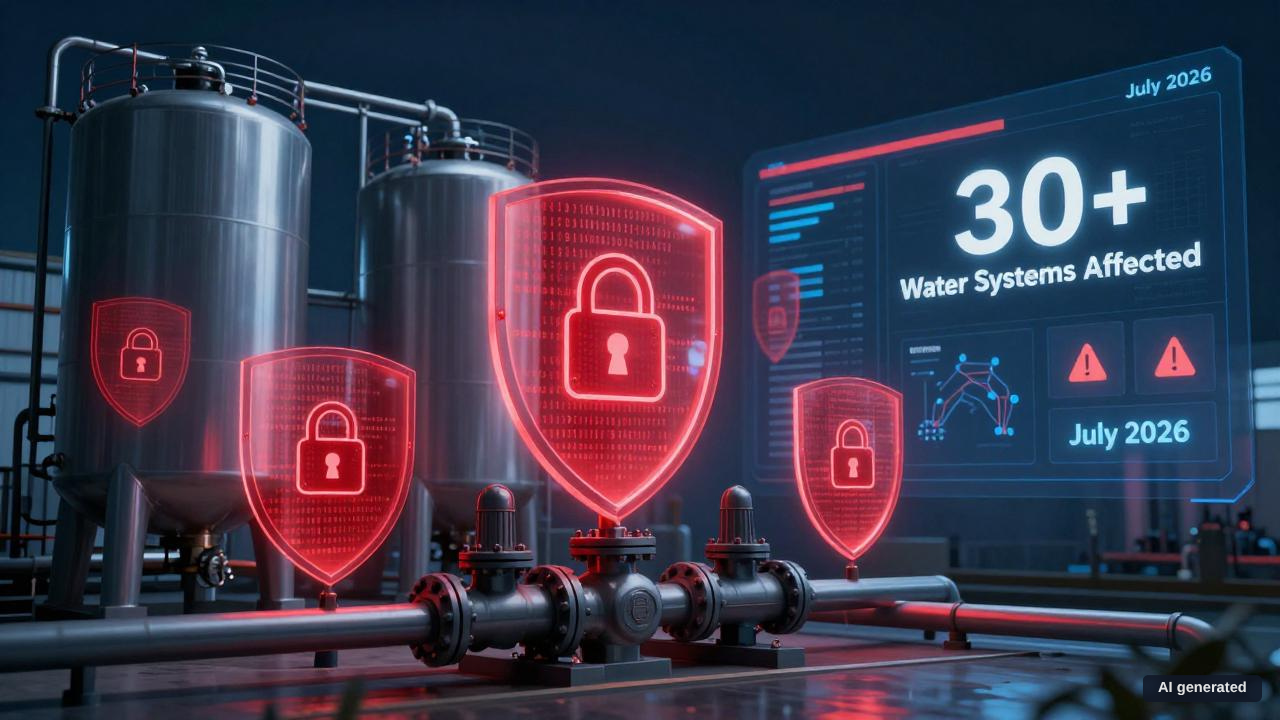
In late July 2026, a quiet but disturbing reality emerged across rural Minnesota. Over 30 community water systems suddenly lost connection to their remote facilities. Control panels went dark. Automated pumps stopped responding. Municipalities scrambled to manually operate valves and pressure regulators—workarounds that would have been unthinkable just days earlier.
This wasn't a power outage or equipment malfunction. It was a coordinated cyberattack targeting operational technology (OT) at the heart of America's critical water infrastructure. And as investigators peel back the layers, the implications stretch far beyond a single state's borders.
> July 22, 2026 — Warning Issued
The U.S. government sounded the alarm before the worst hit. CISA, FBI, NSA, EPA, and federal partners released Joint Cybersecurity Advisory AA26-097A, warning that Iran-affiliated threat actors were targeting internet-accessible industrial controllers across multiple critical infrastructure sectors: water, energy, and public services.
It was a heads-up that would prove prescient.
> July 26–27, 2026 — Attacks Strike
Less than a week later, the warnings materialized into action. More than 30 water utilities across Minnesota experienced simultaneous disruptions:
- Communication losses affecting remote pump stations and reservoir monitoring
- Automated control systems became unavailable or unresponsive
- Manual procedures temporarily deployed to maintain water delivery
Utilities were forced to fall back on decades-old operational methods—walking to remote sites, turning valves by hand, recording pressure readings with clipboards. The irony wasn't lost on engineers: technology meant to make water systems safer had become their weakest link.
> July 28–August 1, 2026 — Investigation Expands
By early August, investigators had expanded their scope. Similar suspicious activities were being examined in at least seven other U.S. states. However, thanks to swift detection and manual fallback procedures, no confirmed water quality degradation or public health consequences were reported.
The attack disrupted operations—but it didn't poison America's tap water. For now, at least, the worst-case scenario was avoided.
What we know so far
> High Confidence
✅ OT systems supporting water distribution and treatment were targeted
The evidence is clear: attackers reached the operational technology layer—the programmable logic controllers (PLCs), industrial switches, and sensor networks that physically control water flow, pressure, and treatment chemical dosing. This wasn't a phishing email compromising office computers. This was direct infiltration of the machinery itself.
> Moderate Confidence
⚠️ The incidents may connect to a broader campaign targeting internet-accessible industrial controllers
The timing aligns with the July 22 advisory, and the technical patterns suggest a coordinated approach. However, investigators caution that correlation doesn't equal causation. Multiple attack vectors could produce similar effects.
> Still Unconfirmed
❓ Direct Iranian involvement, specific vulnerabilities exploited, or PLC logic modification in Minnesota
While authorities are studying possible links to Iran-affiliated actors, no definitive attribution has been announced. Similarly, the exact initial access method—whether an exposed PLC, an undocumented cellular modem, or insufficiently controlled contractor access—remains undisclosed.
Analysis Limitation: As of August 1, 2026, this assessment relies on publicly available information. The initial access vector, specific equipment affected, and threat actor identity have not been confirmed by investigative authorities.
Lessons Learned
Perhaps the most sobering insight from this incident is how easily attackers bypassed traditional IT perimeter defenses.
For years, organizations have built layered security architectures assuming that compromising the corporate network was a prerequisite for reaching critical operational systems. The Minnesota attacks shattered that assumption.
Three pathways allowed attackers to reach OT environments directly:
The takeaway is stark: an OT environment can be compromised without first breaching the traditional IT network.
This fundamentally changes the threat model for every organization managing critical infrastructure. You can't defend what you can't see, and many water utilities discovered they couldn't see—or control—all the ways attackers might reach their systems.
These aren't quick fixes. Building cybersecurity into critical infrastructure requires months—or years—of sustained effort. But the alternative is unthinkable: water systems vulnerable to disruption by actors anywhere in the world.
What organizations should do NOW
The Minnesota incidents aren't isolated. They're symptomatic of systemic vulnerabilities across U.S. critical infrastructure:
As investigators continue their work, one thing is certain: the Minnesota attacks were a test—and possibly a preview. If adversaries successfully penetrate water networks in one state, they've proven the concept works elsewhere.
Immediate Actions (Next 30 Days)
- Identify all internet-facing OT assets - Scan and remove direct exposure of PLC's and HMI's
- Verify current network segmentation - Ensure OT and IT networks are properly isolated (Unidirectional OT to IT flows only)
- Review third-party access - Audit all contractor and system integrator permissions
- Offline/immutable backups - backup critical (all) PLC's and OT assets config, handle change management
- Test manual operating procedures - Can your team sustain operations without automation?
Medium-Term Investments (3–12 Months)
- Deploy OT sensors - Passive scanning from Span port(s) to list all of assets and flows, detection tuned on OT protocols
- Design and build proper network segmentation - segment based on IEC62443 guidelines, isolate the most risky assets (diode)
- Design and build PAM and Zero Trust remote Access with MFA - secure third-party remote access based
- Contract IR retainer for OT and conduct tabletop exercises — Practice incident response with operations and IT teams together
Long-Term Strategy (12–24 Months)
- Deploy OT-specific SOC monitoring — Select OT detection use-cases, identify local SPoC, build response workflows, converge IT/OTSOC
- Implement risk-based vulnerability management for OT — Work with technology vendors and business owners to balance security and uptime
- Modernize legacy systems — Plan for secure replacements of unsupported equipment; if not possible run them under a secure OS umbrella (iGEL)
Key Takeaways
The Human Element
Behind every compromised PLC and disconnected sensor are real people with real responsibilities.
The operator who drove to a remote pump station at 2 a.m. to manually start water flow after control systems failed. The engineer who spent 48 straight hours verifying water quality data while hackers remained undetected. The municipal administrator who explained to city council why a cyberattack could shut down water service—but didn't.
These weren't hypothetical threats anymore. They were Tuesday morning realities.
And in the end, what kept the lights on and the taps flowing wasn't just technology. It was expertise, preparedness, and the willingness to do the hard, manual work when automation failed. That's the real resilience story hidden beneath the headlines.
Summary
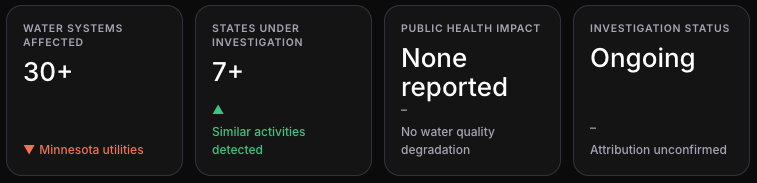
✅ Water systems were targeted — Over 30 Minnesota utilities affected; 7+ additional states under investigation.
✅ OT can be breached independently — Attackers reached operational technology without compromising IT networks.
✅ Public health held steady — No confirmed water quality degradation or health impacts reported.
✅ Attribution pending — Possible Iranian involvement under study, but no definitive conclusions.
✅ Manual procedures matter — Back-to-basics operations prevented cascading failures.
✅ Vulnerabilities are systemic — Exposed PLCs, undocumented modems, and lax contractor access remain widespread.
Resources
Disclaimer: This article synthesizes publicly available information as of early August 2026. Attribution and technical details remain under investigation by U.S. federal authorities. Organizations should consult official advisories and threat intelligence feeds for the latest guidance.

Zero Trust Security enabled.
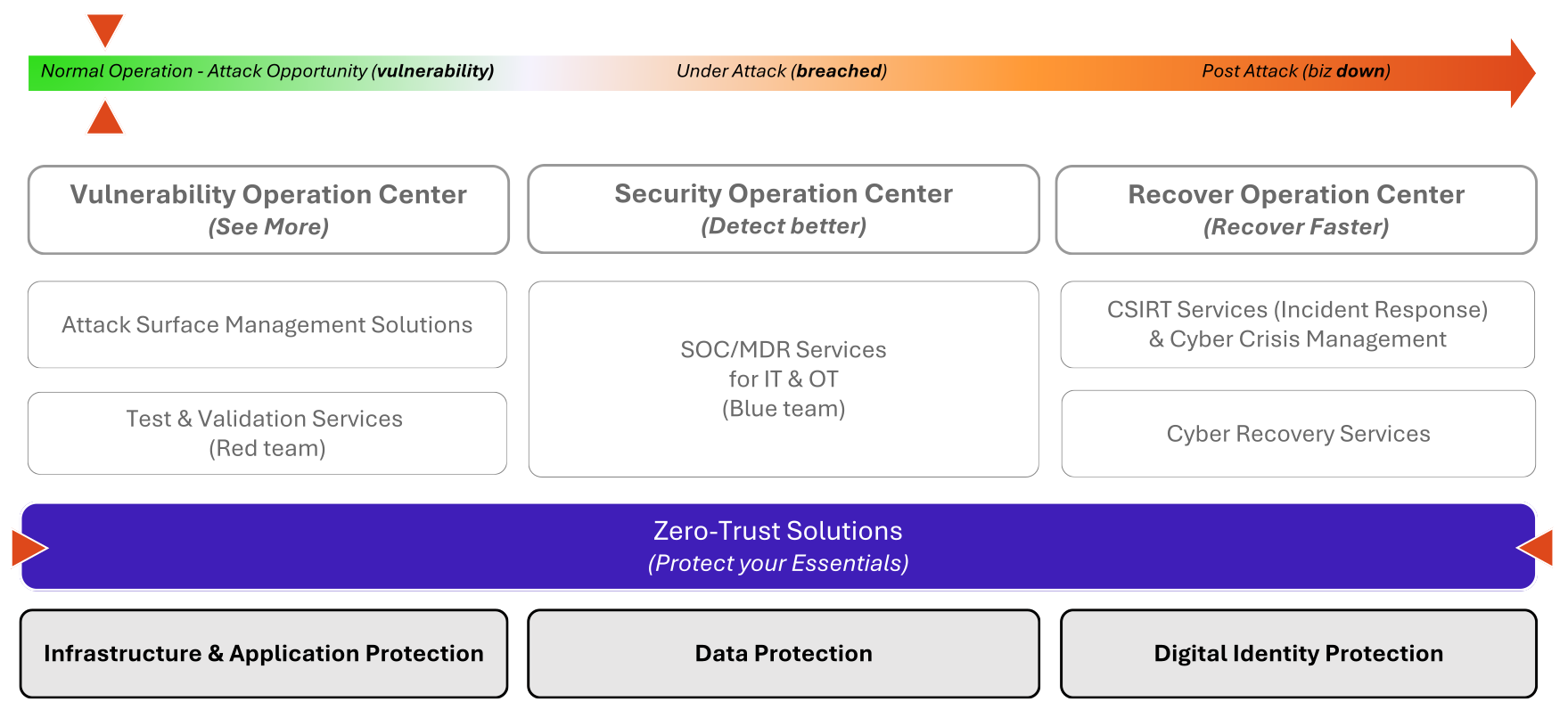


Zero Trust Security enabled.