Q-Day: why should you prepare for post-quantum cryptography now?
Published: August 7, 2026 | Stéphane Rabette | Reading Time: ~10 minutes
Imagine this scenario: A Swiss precision machinery manufacturer discovers that a competitor has suddenly begun selling a near-identical product—at half the price. After investigation, it turns out that encrypted production blueprints, formulas, and engineering specifications were silently intercepted years earlier. At the time, the encryption seemed unbreakable. But by the time the theft was discovered, a cryptographically relevant quantum computer had already decrypted the stolen data. This is not science fiction. Germany's Federal Office for Information Security (BSI) has described precisely this scenario as one of the most dangerous—yet underappreciated—threats facing the industrial sector today.
This article explores why the so-called "Q-Day"—the moment a quantum computer can break current public-key cryptography—is closer than many assume, what it means for Swiss industry, and how organizations can begin their migration to post-quantum cryptography (PQC) before it's too late.
What Is Q-Day?
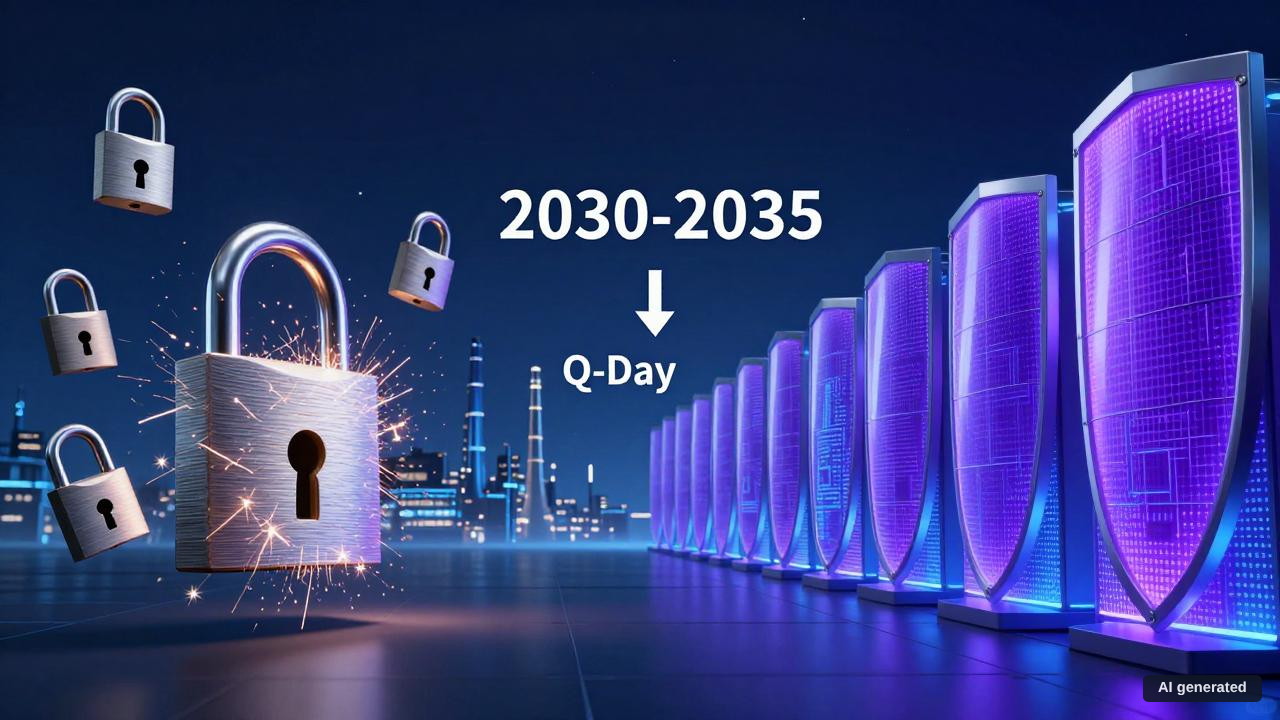
Q-Day refers to the point at which a cryptographically relevant quantum computer (CRQC) becomes capable of breaking widely deployed public-key algorithms such as RSA, Diffie-Hellman, and elliptic curve cryptography (ECC). These algorithms currently underpin virtually all digital communications, from TLS-encrypted web traffic to VPN tunnels, software signing, and industrial control system authentication.
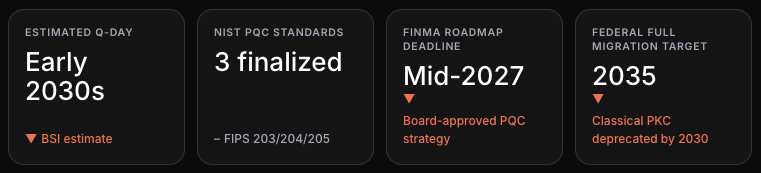
The BSI now works on the hypothesis that a cryptographically relevant quantum computer could exist by the early 2030s. Crucially, the BSI frames this not as a speculative forecast but as an operational risk that demands action today. The agency, together with partners from more than 18 European states, published a joint statement in November 2024 urging industry, critical infrastructure providers, and public administrations to begin the transition to post-quantum cryptography immediately.
Recent research has also suggested that fewer qubits than previously expected may be needed to break current encryption schemes, further compressing the timeline and intensifying the urgency.
The "Harvest Now, Decrypt Later" Threat
The most insidious aspect of the quantum threat is that it is already happening. Adversaries don't need to wait for Q-Day to start exploiting today's encryption weaknesses. Instead, they employ a strategy known as "Harvest Now, Decrypt Later" (HNDL):
- Harvest: Attackers intercept and store encrypted data transiting through networks—including CAD files, production parameters, trade secrets, financial records, and supply-chain communications.
- Wait: The stolen ciphertext is archived, sometimes for years.
- Decrypt: Once a sufficiently powerful quantum computer becomes available, the stored data is decrypted and exploited.
This means that data encrypted with today's algorithms is effectively running on borrowed time. Any sensitive information with a long confidentiality lifetime—engineering designs, pharmaceutical formulas, military specifications, legal contracts—is already at risk.
The Industrial Espionage Scenario
The BSI has been particularly vocal about the industrial dimension of this threat. In a scenario the agency has described publicly, a manufacturer's confidential production plans are intercepted today and stored as encrypted ciphertext. Years later, when quantum decryption becomes feasible, attackers decrypt the data and use it to produce cheaper copies of complex machinery. By the time the original manufacturer detects the IP theft, the damage is already done—the competitor has captured market share.
For Swiss industries—particularly pharmaceuticals, precision manufacturing, financial services, and biotechnology—where intellectual property represents a core competitive advantage, this scenario is especially alarming.
NIST Post-Quantum Foundations
In August 2024, the U.S. National Institute of Standards and Technology (NIST) published the first three finalized post-quantum cryptography standards:
In March 2025, NIST also selected HQC as a backup key encapsulation algorithm, built on different mathematical foundations (error-correcting codes) to provide algorithmic diversity in case lattice-based cryptography encounters unexpected vulnerabilities.
These standards represent the culmination of an eight-year global competition and provide a stable foundation for organizations to begin migration planning. The U.S. government has set a target of full PQC migration by 2035 for national security systems, with classical algorithms deprecated by 2030.
The Swiss Regulatory Context
Switzerland is taking a coordinated, multi-agency approach to quantum readiness:
Federal Council Action Plan
The Swiss Federal Council has acknowledged the accelerating quantum risk landscape and issued an Action Plan calling for:
- Assessment of all affected business and technology components
- Minimization of new legacy systems through quantum-safe procurement
- Immediate mitigation of "harvest now, decrypt later" exposures
- Implementation of a migration plan to quantum-safe cryptography
- Alignment with international standards (NIST, EU recommendations)
- Continuous review and adaptation of quantum strategies
FINMA Guidance 05/2026
On July 9, 2026, the Swiss Financial Market Supervisory Authority (FINMA) published formal quantum computing guidance for supervised institutions. Key requirements include:
- A board-approved PQC migration strategy with clear milestones and priorities
- Target dates for complete migration and for migrating critical business processes first
- A PQC roadmap to be completed by mid-2027
- Integration of the migration into overall cyber-risk governance
Upcoming Swiss Legislation
Switzerland is preparing a "Cyberresilienz von digitalen Produkten" law mirroring the EU Cyber Resilience Act, with a consultation draft expected in autumn 2026. While this legislation focuses on product cybersecurity broadly, quantum-safe requirements are expected to be incorporated.
Rest of the World Regulatory Context
Europe
The EU PQC Roadmap recommends that products entering the market with an expected lifetime beyond 2030 be upgradable to PQC and the EU Cyber Resilience Act requires state-of-the-art encryption for products entering the EU market after 2027. France's ANSSI plans to stop certifying security products that lack quantum-resistant cryptography from 2027.
United States
NIST deprecates quantum-vulnerable algorithms after 2030. An executive order from June 2026 sets hard deadlines for federal PQC migration: key establishment by December 2030 and digital signatures by December 2031.
United Kingdom
The NCSC expects companies to complete cryptographic discovery by 2028 and priority migration by 2031.
Practical Migration Roadmap
Why a "Big Bang" Migration Won't Work
The NCSC (UK), BSI (Germany), and CISA (US) all agree on one point: a "big bang" approach to PQC migration is unrealistic, especially in industrial environments. The reasons include:
- Long-lived equipment: Industrial control systems, SCADA networks, and embedded devices may have operational lifespans of 15–25 years, making cryptographic updates extremely challenging.
- Complex maintenance windows: Manufacturing and critical infrastructure environments cannot afford downtime for cryptographic overhauls.
- Supply-chain dependencies: Many systems rely on third-party components whose cryptographic libraries are controlled by vendors.
- Deeply embedded cryptography: Public-key algorithms are woven into certificate hierarchies, VPNs, machine identities, software-signing pipelines, firmware update mechanisms, and industrial protocols.
- Performance trade-offs: The NCCoE's SP 1800-38 practice guide found approximately 50% throughput reduction in hybrid classical/PQC deployment configurations—a significant consideration for real-time industrial systems.
Large enterprises beginning migration in 2026 should not expect full completion before the early 2030s—which means organizations that delay starting face a credible risk that their most sensitive historical communications will still be quantum-vulnerable when CRQCs arrive.
Based on guidance from BSI, NIST, CISA, and FINMA, here is a phased approach for Swiss organizations:
Phase 1: Discover and Inventory (2026)
- Conduct a Cryptographic Inventory Map all cryptographic assets across the enterprise: algorithms used, key lengths, certificates, protocols, embedded systems, cloud services, and supply-chain dependencies. Automated discovery tools are strongly recommended.
- Classify Data by Confidentiality Lifetime Identify which data has long-term sensitivity (engineering designs, trade secrets, financial models, legal documents). These are the highest-priority targets for HNDL attacks.
- Assess Vendor Readiness Engage with technology suppliers to understand their PQC roadmaps. Ensure that new procurement includes quantum-safe requirements.
Phase 2: Pilot and Hybrid Deployment (2027)
- Deploy Hybrid Classical/PQC Encryption Begin with hybrid TLS configurations that combine classical algorithms (ECC) with post-quantum algorithms (ML-KEM). This provides protection against both current and future threats during the transition period.
- Pilot PQC in Non-Production Environments Test ML-KEM, ML-DSA, and SLH-DSA in staging environments. Measure performance impact, compatibility issues, and operational implications.
- Prioritize Critical Systems Focus initial migration on systems protecting the most sensitive, long-lived data. For financial institutions, FINMA expects critical business processes to be migrated first.
Phase 3: Systematic Migration (2027–2029)
- Replace Vulnerable Algorithms Systematically replace RSA and ECDH with ML-KEM for key establishment. Transition signature verification to ML-DSA or SLH-DSA where appropriate.
- Update Firmware and Software Signing Implement PQC-based firmware signing for IoT devices, industrial controllers, and embedded systems.
- Engage Notified Bodies and Auditors For regulated industries, ensure PQC migration is integrated into compliance frameworks and audit cycles.
Phase 4: Full Transition (2030–2035)
- Deprecate Classical Public-Key Algorithms Complete the transition to quantum-safe cryptography across all systems, following the NIST-recommended timeline of classical algorithm deprecation by 2030 and exclusive PQC use by 2035.
- Maintain Crypto-Agility Establish processes for rapid cryptographic algorithm replacement in the future, ensuring the organization can respond to new threats without wholesale system overhauls.
Key Takeaways
Microsoft and IBM both expect to deliver quantum computers by 2029. Google and Cloudflare have set the same year as their target for full post-quantum migration: less than 1% network overhead, with zero user-visible impact when enabling PQC TLS key exchange on your web applications.
✅ The quantum threat is already active. "Harvest Now, Decrypt Later" attacks are happening today—your encrypted data is being collected for future decryption.
✅ Standards are ready. NIST FIPS 203, 204, and 205 provide a stable foundation for migration. There is no longer an excuse to wait.
✅ Switzerland is moving. FINMA requires supervised institutions to have a PQC roadmap by mid-2027. The Federal Council has issued an Action Plan for quantum-safe migration.
✅ Industrial sectors are most at risk. Long-lived equipment, embedded systems, and valuable intellectual property make manufacturing, pharma, and biotech especially vulnerable to HNDL attacks.
✅ Start with inventory. You cannot protect what you don't know you have. A comprehensive cryptographic inventory is the essential first step.
How Abilene Solutions Can Help
Together with our partner Thales, we supports organizations through every phase of their post-quantum journey:
- Executive Briefings — Ensuring leadership and technical teams understand the quantum threat and their roles in mitigation
- Cryptographic Inventory and Gap Analysis — Automated discovery and mapping of all cryptographic assets across your enterprise
- Hybrid Deployment Pilots — Testing and deploying hybrid classical/PQC configurations in your environment
- PQC Migration Strategy Development — Board-level strategy documents aligned with FINMA, BSI, and NIST guidance
Resources and Further Reading
- Thales - PQC crypto agility
- BSI – Quantum Technologies and Quantum-Safe Cryptography
- NIST Post-Quantum Cryptography Standards
- CISA Post-Quantum Cryptography Initiative
- FINMA Guidance 05/2026 on Quantum Computing
- Q-Day Is Getting Closer – DirectIndustry eMag
- Joint European Statement on PQC (BSI, November 2024)

Zero Trust Security enabled.
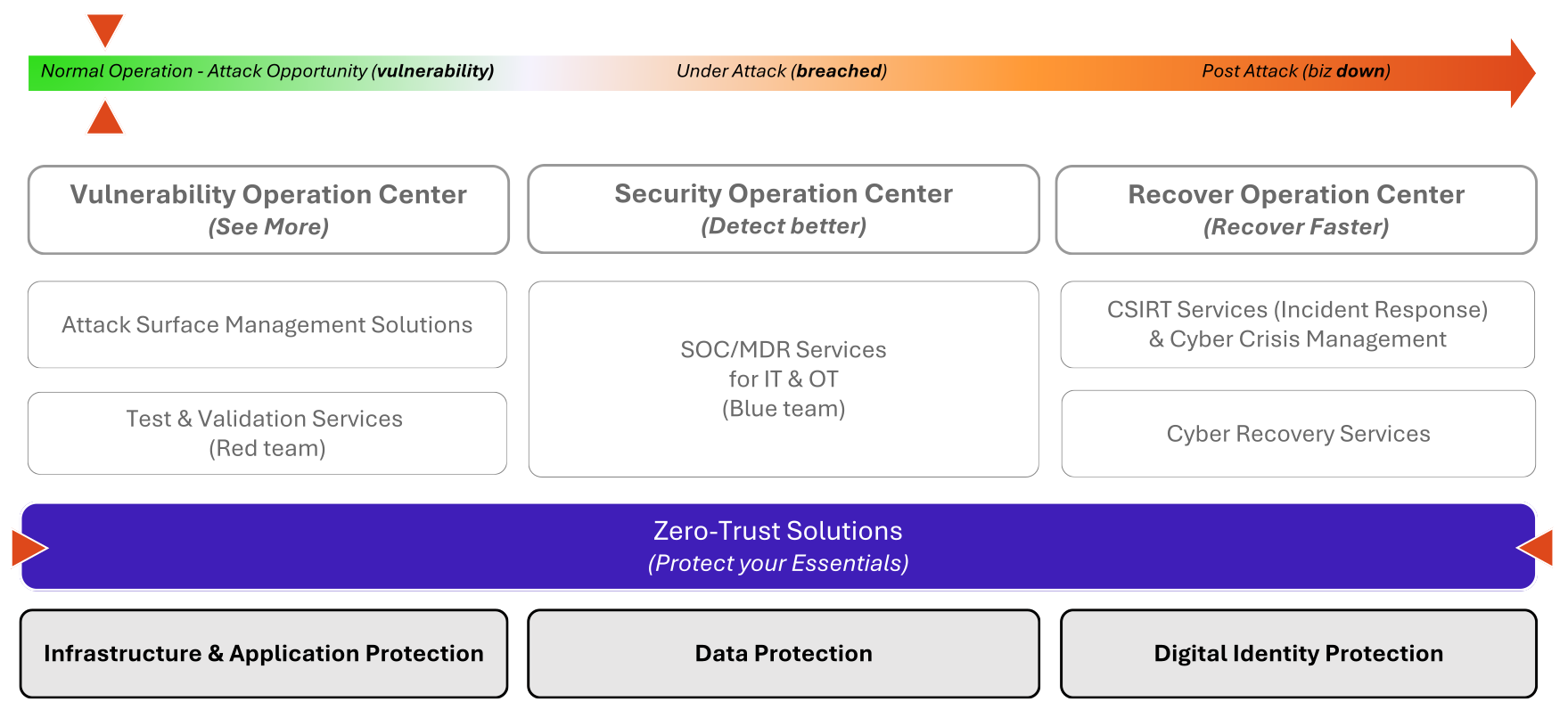


Zero Trust Security enabled.