How Digital Twin Technology Transforms Cybersecurity in Industrial Systems
Published: July 31, 2026 | Stéphane Rabette | Reading Time: ~8 minutes
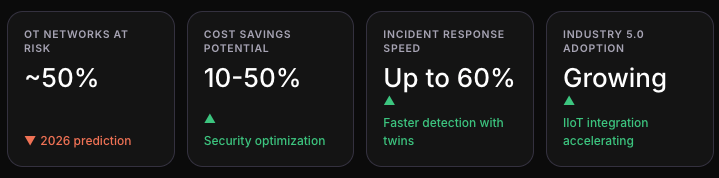
Roughly 50% of industrial OT networks are predicted to be compromised in 2026. Digital twin technology can drive 10–50% cost savings through optimized security configurations, accelerate incident response by up to 60% via AI-powered anomaly detection, and is seeing growing adoption as Industry 5.0 and IIoT connectivity expand.
Digital twins directly support compliance with the EU Cyber Resilience Act (documented vulnerability testing without production disruption), NIS2 Directive (incident response preparedness through simulation), IEC 62443 (security zone conformance validation), CISA KEV requirements (remediation strategy testing), and FINMA cyber requirements (security controls maturity evidence). For Swiss organizations facing the CRA's September 2026 reporting deadline, digital twins provide auditable evidence of security testing and patch validation—strengthening compliance posture without operational risk.
Industrial cybersecurity has traditionally operated in a high-stakes environment where testing security controls often risks disrupting critical production processes. Enter digital twin technology—a revolutionary approach that creates virtual replicas of physical operational technology (OT) systems, enabling organizations to test, monitor, and strengthen their security posture without ever touching production infrastructure.
As Industry 5.0 accelerates and IIoT connectivity expands, digital twins are rapidly becoming a cornerstone of mature OT security programs. This article explores how this technology transforms industrial cybersecurity, the three main challenges organizations must overcome, and practical guidance for implementation.
What Is a Digital Twin in Industrial Cybersecurity?
A digital twin is a near-perfect virtual replica of a physical industrial system, network, or process. In the context of OT cybersecurity, it creates a real-time mirroring environment that behaves identically to the physical system it represents—down to PLC responses, sensor readings, network packet flows, and protocol interactions.
Unlike traditional IT security testing environments, digital twins provide bidirectional data flows between cybersecurity models and the operational environment. Security teams can:
- Monitor system behavior in real-time
- Detect anomalies before they escalate into incidents
- Simulate cyberattack scenarios safely
- Test patches and configuration changes
- Train staff on incident response procedures
- Validate security controls without risking downtime
Key Insight: Digital twins serve as consequence-free laboratories where security teams can identify vulnerabilities and test defenses before malicious actors discover them in production.
Four Ways Digital Twins Transform Industrial Security
1. Safe Attack Simulation and Red Teaming
Traditional penetration testing of OT environments requires extreme caution—a single misstep can halt production, trigger safety incidents, or damage equipment. Digital twins eliminate this constraint entirely.
Security teams can:
- Execute full attack chains against the virtual environment
- Test ransomware deployment scenarios
- Simulate insider threat activities
- Validate detection capabilities across all security layers
- Measure mean time to detect (MTTD) and respond (MTTR)
Result: Organizations gain actionable intelligence about defensive gaps without operational risk.
2. Real-Time Anomaly Detection and Predictive Analytics
When coupled with AI-driven threat analytics, digital twins become powerful detection engines. By continuously comparing real-world system behavior against expected patterns in the virtual model, anomalies become immediately visible.
Benefits include:
- Early warning for zero-day exploits
- Detection of lateral movement attempts
- Identification of configuration drift
- Prediction of component failures before they occur
- Automated correlation of security events with operational impacts
Research indicates that digital twins can reduce incident response times by up to 60% when integrated with SIEM and SOAR platforms.
3. Patch Validation and Change Management
Before deploying security patches to production OT systems, digital twins allow teams to verify:
- Compatibility with existing applications
- Performance impact on control loops
- Integration with legacy protocols
- Rollback procedures if issues arise
This reduces the likelihood of patch-induced outages while ensuring security updates are applied confidently and efficiently.
4. Training and Skills Development
Cybersecurity skills gaps remain a critical challenge in industrial environments. Digital twins provide safe, realistic training grounds for:
- SOC analysts learning OT-specific attack patterns
- Engineers understanding security implications of design choices
- Incident responders practicing breach containment procedures
- Management teams experiencing tabletop exercises with real-time data
Major OEMs including Siemens, Honeywell, ABB, and AVEVA are increasingly incorporating digital twin capabilities into their OT security portfolios.
Three Critical Challenges to Implementation
Despite compelling benefits, digital twin deployments face significant hurdles that organizations must address strategically.
Challenge #1: Data Reliability and Model Accuracy
The Problem: A digital twin is only as valuable as the fidelity of its data inputs. Inaccurate sensor readings, stale network topology information, or incomplete process parameters result in a "ghost twin" that diverges from reality—rendering anomaly detection ineffective.
Considerations:
- Bidirectional data integrity must be maintained between physical and virtual systems
- Sensitive process data ownership and privacy requirements complicate data sharing
- Legacy systems often lack standardized interfaces for data export
- High-fidelity models require continuous calibration as production systems evolve
Recommendation: Start with focused twins of critical network segments or high-risk devices rather than attempting enterprise-wide replication immediately. Build data quality assurance processes before scaling.
Challenge #2: Implementation Complexity and Integration
The Problem: Industrial environments typically comprise heterogeneous systems spanning decades of technological evolution—from decade-old PLCs to cutting-edge IIoT sensors. Integrating these disparate data streams into a coherent digital representation demands substantial engineering effort.
Considerations:
- Standardization gaps in OT protocols and ontologies hinder unified modeling
- Scaling high-fidelity twins across large, distributed infrastructures strains computational resources
- Skill gaps exist in both digital twin development and OT security domains
- Upfront investment can be substantial before measurable ROI emerges
Recommendation: Develop a phased roadmap prioritizing business-critical assets. Partner with experienced integrators who understand both cybersecurity and industrial automation contexts. Leverage existing vendor solutions where possible rather than building custom twins.
Challenge #3: Expanded Attack Surface Risk
The Problem: Paradoxically, implementing a digital twin can create new security vulnerabilities if not properly secured. The twin itself becomes an attractive target—if compromised, adversaries could:
- Poison training data to blind anomaly detection systems
- Extract sensitive operational intelligence from the model
- Use the twin as a staging ground for attacks against production systems
- Manipulate virtual controls to trigger false alarms or mask real threats
Considerations:
- AI-enhanced threats are proliferating across increasingly interconnected OT networks
- Secure separation between twin infrastructure and production networks is essential
- Access controls and audit logging must be as rigorous as production systems
- Regular security assessments of the twin environment are mandatory
Recommendation: Apply the same security standards to your digital twin infrastructure as you would to production systems. Implement network segmentation, encryption in transit and at rest, multi-factor authentication, and continuous monitoring. Treat the twin as a critical asset requiring protection, not just a testing tool.
Practical Implementation Roadmap
Phase 1: Assessment and Planning (Months 1–3)
Phase 2: Pilot Deployment (Months 4–9)
Phase 3: Expansion and Optimization (Months 10–18)
Case Studies: Digital Twins in Action
Power Grid Protection: European utility deployed digital twins of substations to simulate ransomware attacks targeting SCADA systems. The exercise revealed detection gaps in legacy protocols, leading to targeted security control enhancements before any real incident occurred.
Pharmaceutical Manufacturing: A Swiss pharma company used digital twins to validate patch compatibility with GMP-regulated manufacturing equipment. This reduced patch deployment risk by 75% while maintaining regulatory compliance throughout the update cycle.
Water Treatment Facilities: Ffollowing Iran-linked threat actor activity against Cal Water, utilities adopted digital twins to practice incident response scenarios. Response times improved from hours to minutes during subsequent simulated attacks.
Key Takeaways
✅ Digital twins enable safe security testing — Red teaming, patch validation, and attack simulation occur without production disruption.
✅ Real-time monitoring enhances detection — AI-powered comparison between virtual and physical systems identifies anomalies faster than manual methods.
✅ Three challenges require strategic addressing — Data reliability, implementation complexity, and expanded attack surface risks must be managed proactively.
✅ ROI emerges through multiple channels — Cost savings, faster incident response, improved training, and regulatory compliance all contribute to business value.
✅ Start small, think big — Begin with pilot projects on critical assets before scaling to enterprise-wide implementations.
Resources and Further Reading
How Abilene Solutions Can Help
Our team specializes in bridging cybersecurity and operational technology through advanced technologies including digital twins. We support Swiss organizations with:
- Digital Twin Strategy Development — Assessing feasibility and designing implementation roadmaps aligned with business objectives
- OT Security Program Integration — Embedding digital twins into broader cybersecurity frameworks and compliance programs
- Attack Simulation Services — Running red team exercises against virtual environments to validate detection and response capabilities
- Training and Knowledge Transfer — Building internal competency in digital twin technologies and OT security practices
- Vendor Selection Support — Evaluating technology platforms and integrating with existing security infrastructure
Whether you're beginning your digital twin journey or seeking to optimize an existing deployment, we are looking for customers to jointly explore and operationnalize this concept.

Detect better. Stop adversary.
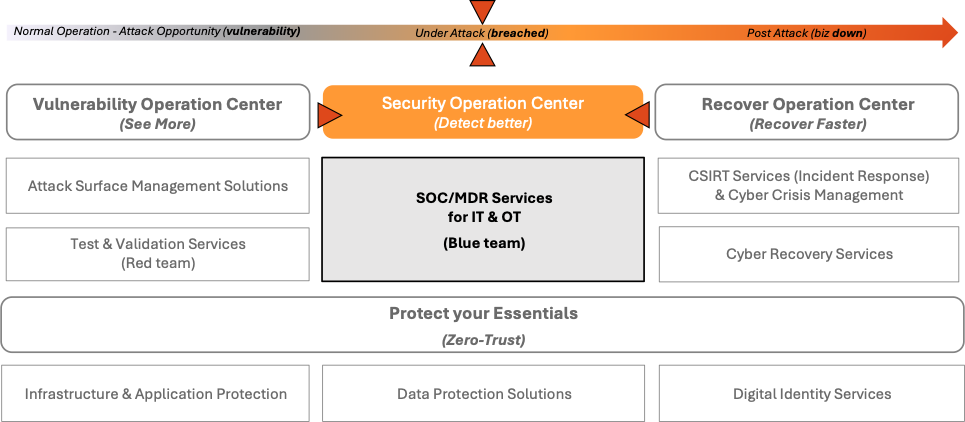


Detect better. Stop adversary.