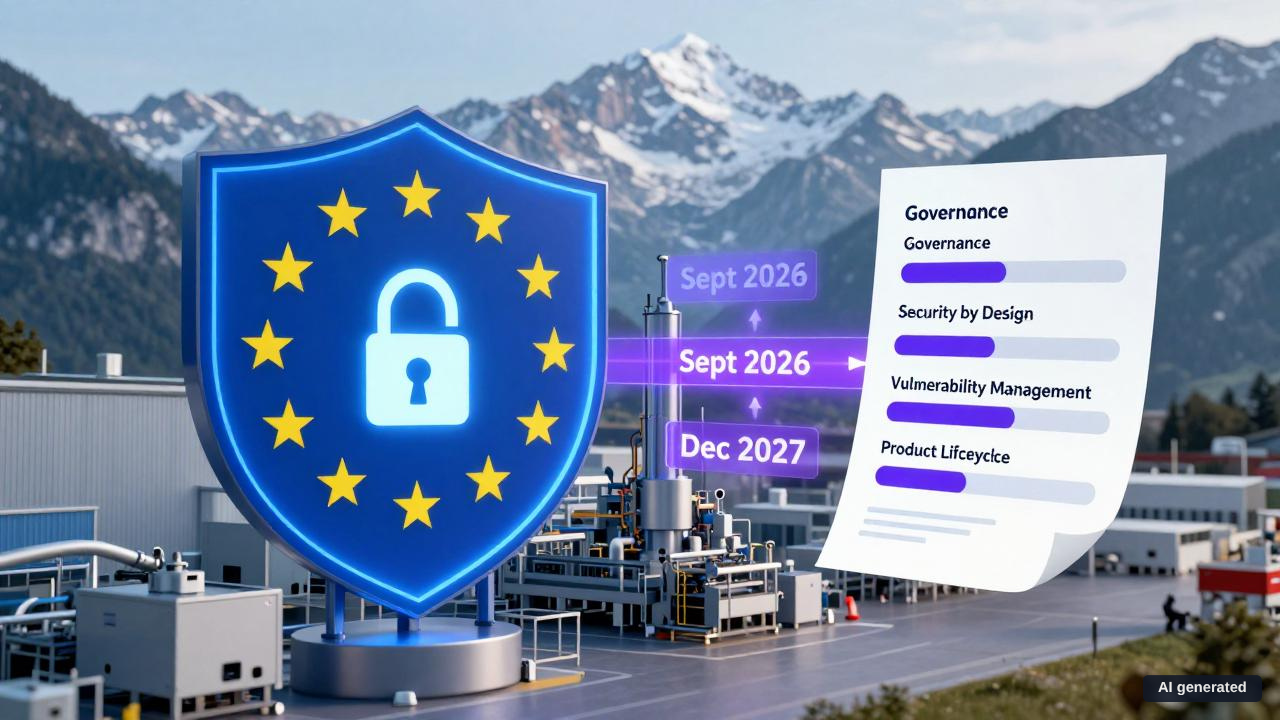
The EU Cyber Resilience Act: A Practical Guide for Swiss Manufacturers and SMEs
Published: July 7, 2026 | Stéphane Rabette | Reading Time: ~8 minutes
The European Union's Cyber Resilience Act (CRA) represents the most significant shift in product cybersecurity regulation to date. For Swiss companies developing, manufacturing, or distributing products with digital elements, understanding and preparing for CRA compliance is no longer optional—it's a critical business imperative.
This article examines what the CRA means for Swiss organizations, how to leverage ENISA's newly released maturity assessment model, and practical steps to achieve compliance before the key deadlines arrive.
Key Deadlines at a Glance
Important: The September 2026 deadline applies to all products made available on the EU market, including those placed on the market before December 2027.
Why the CRA Matters for Swiss Companies
While Switzerland is not an EU member state, the CRA has extraterritorial reach. According to Regulation (EU) 2024/2847, the legislation applies to any "product with digital elements" placed on the Union market—meaning Swiss manufacturers selling to EU customers must comply with security-by-design, vulnerability handling, and 24-hour incident reporting obligations.
PwC Switzerland notes that roughly 50% of Swiss exports go to the EU, making CRA compliance a market-access requirement for many businesses. Furthermore, Switzerland is developing a parallel "Cyberresilienz von digitalen Produkten" law, with a consultation draft expected in autumn 2026. Preparing for the CRA now positions Swiss companies to align with both frameworks efficiently.
Core CRA Obligations for Manufacturers
The CRA imposes several mandatory duties on manufacturers of products with digital elements:
1. Security-by-Design and Security-by-Default
Products must be designed, developed, and produced according to documented cybersecurity principles. This includes conducting risk assessments, maintaining comprehensive technical documentation, and ensuring minimal attack surfaces.
2. Vulnerability Management and Patching
Manufacturers must establish processes to identify, handle, and remediate vulnerabilities throughout the product lifecycle. Critical products require minimum security support periods of five years; non-critical products require three years.
3. Vulnerability and Incident Reporting
From September 11, 2026, manufacturers must report actively exploited vulnerabilities and severe security incidents to ENISA and national CSIRTs within 24 hours of awareness, with follow-up reports within 72 hours.
4. Documentation and CE Marking
A technical file (including machine-readable Software Bill of Materials), EU Declaration of Conformity, and CE marking are required to demonstrate compliance with essential cybersecurity requirements.
Penalties for Non-Compliance
The stakes are significant. Market surveillance authorities can impose administrative fines structured as follows:
Beyond fines, authorities may require product recalls, restrict market availability, or mandate remediation—potentially affecting thousands of deployed devices.
ENISA's SME Cyber Resilience Maturity Assessment Model
Recognizing the gap between CRA awareness and practical readiness, ENISA published the SME Cyber Resilience Maturity Assessment Model on July 13, 2026. This free, downloadable Excel tool helps micro, small, and medium-sized enterprises evaluate their preparedness across five domains:
The Five Assessment Domains
- Governance and Documentation: Formal security policies, decision traceability, process documentation
- Risk Management and Security by Design/Default: Threat modeling, secure architecture, penetration testing
- Vulnerability Management: Continuous monitoring, patching processes, communication with users
- Product Lifecycle Management: Secure development lifecycle, maintenance, end-of-life procedures
- Cybersecurity Skills: Staff training, competence development, organizational awareness
Each criterion receives a maturity rating (1–5 scale), rolling up into an overall classification of Basic, Intermediate, or Advanced.
What the ENISA Survey Revealed
ENISA's companion survey conducted in February–March 2026 collected responses from 194 organizations across 31 countries. Key findings:
- Approximately two-thirds of SMEs had heard of the CRA
- Most lacked documented processes, dedicated staff, or technical procedures to meet requirements
- Practical understanding of CRA obligations remained limited despite awareness
The maturity model addresses this gap by providing a concrete self-assessment framework.
Practical Steps for CRA Preparation
Immediate Actions (Next Month)
- Run a Maturity Assessment + Gap Analysis: ENISA provides a self-assessment tool to identify gaps across the five domains, but we provide a more advanced one, leveraging our GRC platform, Acuna; Use results to prioritize remediation efforts.
- Conduct Product Portfolio Review: Identify all products with digital elements made available on the EU market. Determine which fall under CRA scope and assess their current security posture.
- Train Your Team: Ensure engineering, security, and product teams understand CRA obligations and their roles in compliance.
Medium-Term Actions (3 Months)
- Build Technical Documentation: Create or update technical files, risk assessments, test results, and SBOMs in machine-readable formats.
- Establish Vulnerability Reporting Infrastructure: Set up processes to detect, validate, and report vulnerabilities within the 24-hour window. Ensure team members understand notification procedures.
Long-Term Actions (+6 Months)
- Implement Security-by-Design Processes: Integrate threat modeling, secure code review, and security testing into development workflows.
- Prepare for Swiss Legislation: Monitor the development of Switzerland's cyber resilience law and align preparations accordingly.
- Establish Ongoing Compliance Monitoring: Implement continuous processes to maintain compliance as products evolve and regulations update.
Common Misconceptions About the CRA
Key Takeaways
✅ The CRA applies extraterritorially > Swiss companies selling to EU customers must comply regardless of location.
✅ Deadlines are approaching > Vulnerability reporting begins September 11, 2026; full compliance required December 11, 2027.
✅ ENISA's maturity model can help > Assess your readiness and identify priority actions.
✅ Penalties are substantial >Non-compliance can result in fi:es up to €15 million or 2.5% of global turnover.
✅ Preparation starts now > Security-by-design cannot be retrofitted; begin integration early in your development cycles.
How Abilene Group Can Help
Navigating CRA compliance requires expertise in cybersecurity, regulatory requirements, and product development lifecycle management. Our team supports Swiss organizations through:
- Awareness: Educating teams on CRA obligations and best practices
- Gap Analysis and Maturity Assessments: Using Acuna GRC platform to identify compliance gaps
- Technical Documentation Development: Creating SBOMs, risk assessments, and conformity documentation
- Security-by-Design Integration: Embedding security into your development processes
- Vulnerability Management Programs: Building vulnerability detection and reporting infrastructure
Whether you're launching new products or managing an existing portfolio, we help ensure your organization meets CRA requirements without disrupting innovation timelines.
Perform your CRA maturity assessment
Explore here
Resources and Further Reading

See more. Stay ahead.


See more. Stay ahead.